


Page 119 - Inventions - A Visual Encyclopedia (DK - Smithsonian)
P. 119
FLY BY WIRE
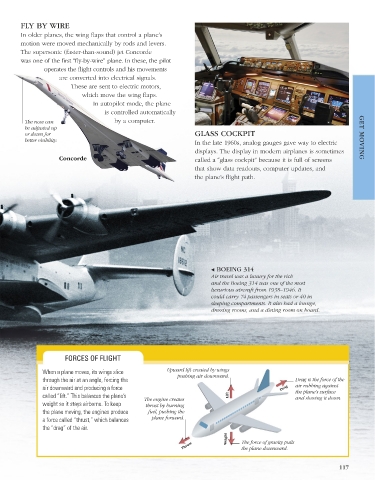
        In older planes, the wing flaps that control a plane’s
        motion were moved mechanically by rods and levers.
        The supersonic (faster-than-sound) jet Concorde
        was one of the first “fly-by-wire” plane. In these, the pilot
               operates the flight controls and his movements
                    are converted into electrical signals.
                        These are sent to electric motors,
                            which move the wing flaps.
                               In autopilot mode, the plane
                                   is controlled automatically
         The nose can                 by a computer.
         be adjusted up
         or down for                                             GLASS COCKPIT
         better visibility.                                                                                            GET MOVING
                                                                 In the late 1960s, analog gauges gave way to electric
                                                                 displays. The display in modern airplanes is sometimes
                    Concorde                                     called a “glass cockpit” because it is full of screens
                                                                 that show data readouts, computer updates, and
                                                                 the plane’s flight path.


                                                                      ◀ BOEING 314
                                                                      Air travel was a luxury for the rich
                                                                      and the Boeing 314 was one of the most
                                                                      luxurious aircraft from 1938–1946. It
                                                                      could carry 74 passengers in seats or 40 in
                                                                      sleeping compartments. It also had a lounge,
                                                                      dressing rooms, and a dining room on board.


                      FORCES OF FLIGHT

               When a plane moves, its wings slice      Upward lift created by wings
               through the air at an angle, forcing the    pushing air downward.                 Drag is the force of the
               air downward and producing a force                                            Drag  air rubbing against
               called “lift.” This balances the plane’s   The engine creates   Lift              the plane’s surface
                                                                                                 and slowing it down.
               weight so it stays airborne. To keep    thrust by burning
               the plane moving, the engines produce    fuel, pushing the
               a force called “thrust,” which balances   plane forward.
               the “drag” of the air.
                                                                           Weight  The force of gravity pulls
                                                            Thrust              the plane downward.


                                                                                                                117


   US_116-117_Taking_to_the_skies_Main.indd   117                                                                08/03/18   3:09 PM

