


Page 118 - Inventions - A Visual Encyclopedia (DK - Smithsonian)
P. 118
Taking to
          Birdlike
              tail


                                                                                the skies


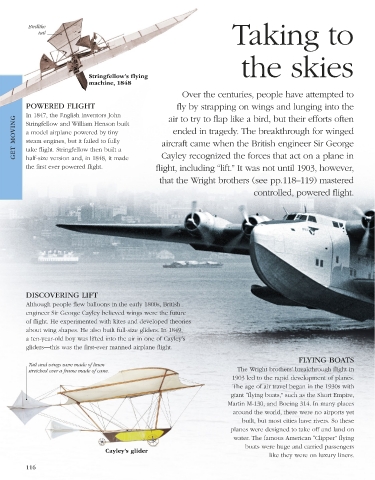
                              Stringfellow’s flying
                              machine, 1848

                                                            Over the centuries, people have attempted to
          POWERED FLIGHT                                   fly by strapping on wings and lunging into the

          In 1847, the English inventors John           air to try to flap like a bird, but their efforts often

      GET MOVING  a model airplane powered by tiny    aircraft came when the British engineer Sir George
          Stringfellow and William Henson built
                                                         ended in tragedy. The breakthrough for winged
          steam engines, but it failed to fully
          take flight. Stringfellow then built a
                                                      Cayley recognized the forces that act on a plane in
          half-size version and, in 1848, it made
          the first ever powered flight.            flight, including “lift.” It was not until 1903, however,

                                                     that the Wright brothers (see pp.118–119) mastered
                                                                                    controlled, powered flight.


          DISCOVERING LIFT
          Although people flew balloons in the early 1800s, British
          engineer Sir George Cayley believed wings were the future
          of flight. He experimented with kites and developed theories
          about wing shapes. He also built full-size gliders. In 1849,
          a ten-year-old boy was lifted into the air in one of Cayley’s
          gliders—this was the first-ever manned airplane flight.
                                                                                                   FLYING BOATS
          Tail and wings were made of linen
          stretched over a frame made of cane.                                 The Wright brothers’ breakthrough flight in
                                                                             1903 led to the rapid development of planes.
                                                                             The age of air travel began in the 1930s with
                                                                            giant “flying boats,” such as the Short Empire,
                                                                           Martin M-130, and Boeing 314. In many places
                                                                             around the world, there were no airports yet
                                                                                built, but most cities have rivers. So these
                                                                            planes were designed to take off and land on
                                                                             water. The famous American “Clipper” flying
                                                                                 boats were huge and carried passengers
                                   Cayley’s glider
                                                                                         like they were on luxury liners.
          116


   US_116-117_Taking_to_the_skies_Main.indd   116                                                                08/03/18   3:09 PM

