


Page 13 - Inventions - A Visual Encyclopedia (DK - Smithsonian)
P. 13
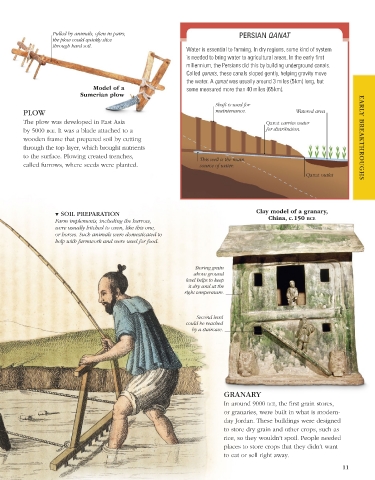
Pulled by animals, often in pairs,                           PERSIAN QANAT
                  the plow could quickly slice
                  through hard soil.
                                                              Water is essential to farming. In dry regions, some kind of system
                                                              is needed to bring water to agricultural areas. In the early first
                                                              millennium, the Persians did this by building underground canals.
                                                              Called qanats, these canals sloped gently, helping gravity move
                                                              the water. A qanat was usually around 3 miles (5 km) long, but
                               Model of a                     some measured more than 40 miles (65 km).
                           Sumerian plow
                                                                       Shaft is used for
         PLOW                                                          maintenance.               Watered area
         The plow was developed in East Asia                                            Qanat carries water
         by 5000 bce. It was a blade attached to a                                      for distribution.
         wooden frame that prepared soil by cutting                                                                    EARLY BREAKTHROUGHS
         through the top layer, which brought nutrients
         to the surface. Plowing created trenches,                This well is the main
         called furrows, where seeds were planted.                source of water.
                                                                                                     Qanat outlet


                   ▼ SOIL PREPARATION                                                Clay model of a granary,
                   Farm implements, including the harrow,                                China, c. 150 bce
                   were usually hitched to oxen, like this one,
                   or horses. Such animals were domesticated to
                   help with farmwork and were used for food.


                                                                 Storing grain
                                                                above ground
                                                              level helps to keep
                                                               it dry and at the
                                                             right temperature.


                                                                 Second level
                                                              could be reached
                                                                by a staircase.


                                                                          GRANARY
                                                                          In around 9000 bce, the first grain stores,
                                                                          or granaries, were built in what is modern-
                                                                          day Jordan. These buildings were designed
                                                                          to store dry grain and other crops, such as
                                                                          rice, so they wouldn’t spoil. People needed
                                                                          places to store crops that they didn’t want
                                                                          to eat or sell right away.
                                                                                                                 11


   US_010-011_Farming_Main.indd   11                                                                             09/03/18   4:06 PM

