


Page 17 - Inventions - A Visual Encyclopedia (DK - Smithsonian)
P. 17
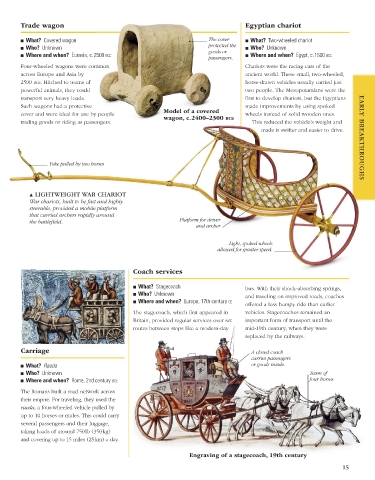
Trade wagon                                                              Egyptian chariot


        ■ ■ What?  Covered wagon                                     The cover    ■ ■ What?  Two-wheeled chariot
        ■ ■ Who?  Unknown                                            protected the    ■ ■ Who?  Unknown
                                                                     goods or
        ■ ■ Where and when?  Eurasia, c. 2500 bce                                ■ ■ Where and when?  Egypt, c. 1600 bce
                                                                     passengers.
        Four-wheeled wagons were common                                          Chariots were the racing cars of the
        across Europe and Asia by                                                ancient world. These small, two-wheeled,
        2500 bce. Hitched to teams of                                            horse-drawn vehicles usually carried just
        powerful animals, they could                                             two people. The Mesopotamians were the
        transport very heavy loads.                                              first to develop chariots, but the Egyptians
        Such wagons had a protective                                             made improvements by using spoked
        cover and were ideal for use by people        Model of a covered         wheels instead of solid wooden ones.
                                                      wagon, c. 2400–2300 bce
        trading goods or riding as passengers.                                     This reduced the vehicle’s weight and
                                                                                      made it swifter and easier to drive.  EARLY BREAKTHROUGHS


                 Yoke pulled by two horses


           ▲ LIGHTWEIGHT WAR CHARIOT
           War chariots, built to be fast and highly
           steerable, provided a mobile platform
           that carried archers rapidly around
           the battlefield.                                 Platform for driver
                                                                 and archer


                                                                            Light, spoked wheels
                                                                        allowed for greater speed.


                                            Coach services


                                            ■ ■ What?  Stagecoach                bus. With their shock-absorbing springs,
                                            ■ ■ Who?  Unknown                    and traveling on improved roads, coaches
                                            ■ ■ Where and when?  Europe, 17th century ce
                                                                                 offered a less bumpy ride than earlier
                                            The stagecoach, which first appeared in   vehicles. Stagecoaches remained an
                                            Britain, provided regular services over set   important form of transport until the
                                            routes between stops like a modern-day   mid-19th century, when they were
                                                                                 replaced by the railways.

        Carriage                                                                   A closed coach
                                                                                   carries passengers
        ■ ■ What?  Raeda                                                           or goods inside.
        ■ ■ Who?  Unknown                                                                             Team of
        ■ ■ Where and when?  Rome, 2nd century bce                                                    four horses
        The Romans built a road network across
        their empire. For traveling, they used the
        raeda, a four-wheeled vehicle pulled by
        up to 10 horses or mules. This could carry
        several passengers and their luggage,
        taking loads of around 750 lb (350 kg)
        and covering up to 15 miles (25 km) a day.

                                                               Engraving of a stagecoach, 19th century
                                                                                                                 15


   US_014-015_Travelling_by_road_Main.indd   15                                                                  08/03/18   3:09 PM

