


Page 220 - Inventions - A Visual Encyclopedia (DK - Smithsonian)
P. 220
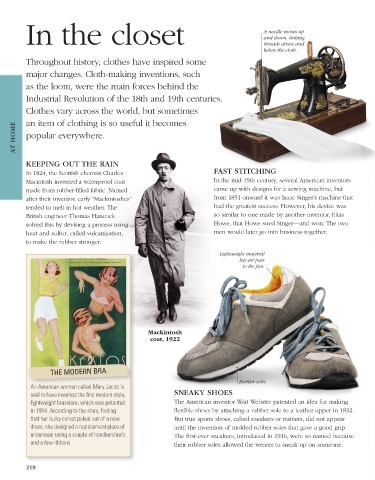
In the closet                                                                A needle moves up

                                                                                       and down, linking
                                                                                       threads above and
                                                                                       below the cloth.
          Throughout history, clothes have inspired some
          major changes. Cloth-making inventions, such

          as the loom, were the main forces behind the
          Industrial Revolution of the 18th and 19th centuries.

          Clothes vary across the world, but sometimes
          an item of clothing is so useful it becomes
      AT HOME  popular everywhere.


          KEEPING OUT THE RAIN

          In 1824, the Scottish chemist Charles                        FAST STITCHING
          Macintosh invented a waterproof coat                         In the mid-19th century, several American inventors
          made from rubber-filled fabric. Named                        came up with designs for a sewing machine, but
          after their inventor, early “Mackintoshes”                   from 1851 onward it was Isaac Singer’s machine that
          tended to melt in hot weather. The                           had the greatest success. However, his device was
          British engineer Thomas Hancock                              so similar to one made by another inventor, Elias
          solved this by devising a process using                      Howe, that Howe sued Singer—and won. The two
          heat and sulfur, called vulcanization,                       men would later go into business together.
          to make the rubber stronger.
                                                                         Lightweight material
                                                                               lets air pass
                                                                                to the feet.


                                                 Mackintosh
                                                  coat, 1922


                  THE MODERN BRA

                                                                               Rubber soles
           An American woman called Mary Jacob is
           said to have invented the first modern-style,   SNEAKY SHOES
           lightweight brassiere, which was patented      The American inventor Wait Webster patented an idea for making
           in 1914. According to the story, finding       flexible shoes by attaching a rubber sole to a leather upper in 1832.
           that her bulky corset poked out of a new       But true sports shoes, called sneakers or trainers, did not appear
           dress, she designed a replacement piece of     until the invention of molded rubber soles that gave a good grip.
           underwear using a couple of handkerchiefs      The first-ever sneakers, introduced in 1916, were so named because
           and a few ribbons.                             their rubber soles allowed the wearer to sneak up on someone.


          218


   US_218-219_In_the_Wardrobe_Main.indd   218                                                                    08/03/18   6:37 PM

