


Page 223 - Inventions - A Visual Encyclopedia (DK - Smithsonian)
P. 223
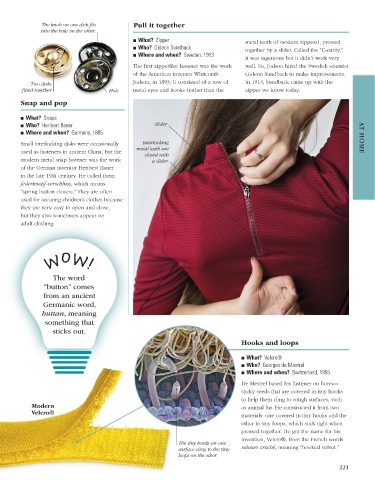
The knob on one disk fits     Pull it together
              into the hole on the other.
                                            ■ ■ What?  Zipper                    metal teeth of modern zippers), pressed
                                            ■ ■ Who?  Gideon Sundback            together by a slider. Called the “C-curity,”
                                            ■ ■ Where and when?  Sweden, 1913
                                                                                 it was ingenious but it didn’t work very
                                            The first zipperlike fastener was the work    well. So, Judson hired the Swedish scientist
                                            of the American inventor Whitcomb    Gideon Sundback to make improvements.
           Two disks                        Judson, in 1893. It consisted of a row of   In 1913, Sundback came up with the
        fitted together              Hole   metal eyes and hooks (rather than the   zipper we know today.
        Snap and pop


        ■ ■ What?  Snaps
        ■ ■ Who?  Heribert Bauer                    Slider
        ■ ■ Where and when?  Germany, 1885                                                                             AT HOME
        Small interlocking disks were occasionally   Interlocking
                                              metal teeth are
        used as fasteners in ancient China, but the
                                                closed with
        modern metal snap fastener was the work    a slider.
        of the German inventor Heribert Bauer
        in the late 19th century. He called them
        federknopf-verschluss, which means
        “spring button closers.” They are often
        used for securing children’s clothes because
        they are very easy to open and close,
        but they also sometimes appear on
        adult clothing.


                WOW!


                  The word
               “button” comes
               from an ancient
               Germanic word,
               buttan, meaning
                something that
                  sticks out.
                                                                                Hooks and loops


                                                                                ■ ■ What?  Velcro®
                                                                                ■ ■ Who?  Georges de Mestrel
                                                                                ■ ■ Where and when?  Switzerland, 1955
                                                                                De Mestrel based his fastener on burrs—
                                                                                sticky seeds that are covered in tiny hooks
                                                                                to help them cling to rough surfaces, such
           Modern                                                               as animal fur. He constructed it from two
           Velcro®                                                              materials: one covered in tiny hooks and the

                                                                                other in tiny loops, which stick tight when
                                                                                pressed together. He got the name for his
                                                                                invention, Velcro®, from the French words
                                                           The tiny hooks on one
                                                           surface cling to the tiny   velours croché, meaning “hooked velvet.”
                                                           loops on the other.
                                                                                                                221


   US_220-221_Fasteners_Gallery.indd   221                                                                       09/03/18   4:06 PM

