


Page 246 - Inventions - A Visual Encyclopedia (DK - Smithsonian)
P. 246
Louis Pasteur


          French biologist and chemist Louis Pasteur was one of the giant
          figures of 19th-century medicine. His many discoveries, particularly

          in the fields of germ theory and vaccination (see pp.242–243),
          revolutionized the scientific thinking of the day. They also saved

          millions of lives by providing great leaps forward in the treatment
      IN GOOD HEALTH  of deadly diseases, such as anthrax and rabies.


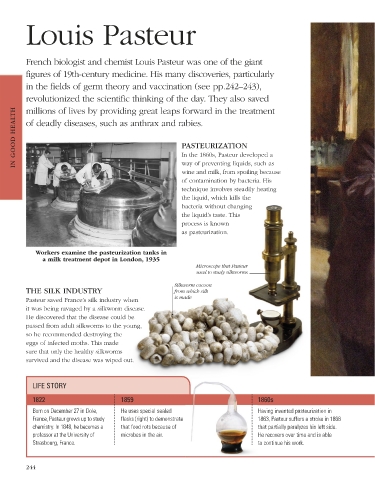
                                                            PASTEURIZATION
                                                            In the 1860s, Pasteur developed a
                                                            way of preventing liquids, such as
                                                            wine and milk, from spoiling because
                                                            of contamination by bacteria. His
                                                            technique involves steadily heating
                                                            the liquid, which kills the
                                                            bacteria without changing
                                                            the liquid’s taste. This
                                                            process is known
                                                            as pasteurization.


             Workers examine the pasteurization tanks in
               a milk treatment depot in London, 1935
                                                                 Microscope that Pasteur
                                                                 used to study silkworms

                                                          Silkworm cocoon
          THE SILK INDUSTRY                               from which silk
          Pasteur saved France’s silk industry when       is made
          it was being ravaged by a silkworm disease.
          He discovered that the disease could be
          passed from adult silkworms to the young,
          so he recommended destroying the
          eggs of infected moths. This made
          sure that only the healthy silkworms
          survived and the disease was wiped out.


            LIFE STORY
            1822                         1859                                        1860s

            Born on December 27 in Dole,   He uses special sealed                    Having invented pasteurization in
            France, Pasteur grows up to study   flasks (right) to demonstrate        1863, Pasteur suffers a stroke in 1868
            chemistry. In 1848, he becomes a   that food rots because of             that partially paralyzes his left side.
            professor at the University of   microbes in the air.                    He recovers over time and is able
            Strasbourg, France.                                                      to continue his work.


          244


   US_244-245_Louis_Pasteur_Inventor.indd   244                                                                  08/03/18   3:10 PM

