


Page 25 - Inventions - A Visual Encyclopedia (DK - Smithsonian)
P. 25
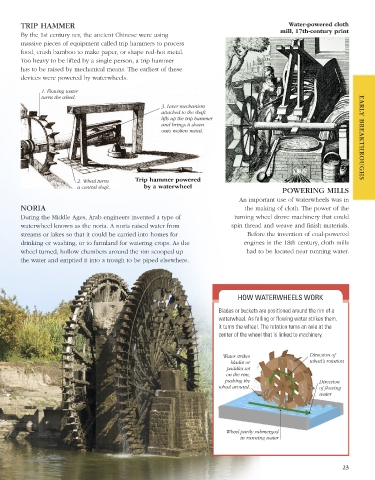
TRIP HAMMER                                                                            Water-powered cloth
        By the 1st century bce, the ancient Chinese were using                               mill, 17th-century print
        massive pieces of equipment called trip hammers to process
        food, crush bamboo to make paper, or shape red-hot metal.
        Too heavy to be lifted by a single person, a trip hammer
        has to be raised by mechanical means. The earliest of these
        devices were powered by waterwheels.

               1. Flowing water
               turns the wheel.
                                                      3. Lever mechanism
                                                      attached to the shaft
                                                      lifts up the trip hammer
                                                      and brings it down
                                                      onto molten metal.                                               EARLY BREAKTHROUGHS


                          2. Wheel turns     Trip hammer powered
                          a central shaft.      by a waterwheel
                                                                                             POWERING MILLS
                                                                               An important use of waterwheels was in
        NORIA                                                                    the making of cloth. The power of the
        During the Middle Ages, Arab engineers invented a type of             turning wheel drove machinery that could
        waterwheel known as the noria. A noria raised water from             spin thread and weave and finish materials.
        streams or lakes so that it could be carried into homes for               Before the invention of coal-powered
        drinking or washing, or to farmland for watering crops. As the           engines in the 18th century, cloth mills
        wheel turned, hollow chambers around the rim scooped up                  had to be located near running water.
        the water and emptied it into a trough to be piped elsewhere.


                                                                               HOW WATERWHEELS WORK
                                                                        Blades or buckets are positioned around the rim of a
                                                                        waterwheel. As falling or flowing water strikes them,
                                                                        it turns the wheel. The rotation turns an axle at the
                                                                        center of the wheel that is linked to machinery.


                                                                          Water strikes               Direction of
                                                                            blades or                 wheel’s rotation
                                                                           paddles set
                                                                           on the rim,
                                                                          pushing the                    Direction
                                                                        wheel around.                    of flowing
                                                                                                         water


                                                                           Wheel partly submerged
                                                                               in running water


                                                                                                                 23


   US_022-023_The_Begnining_of_industry_Main.indd   23                                                           08/03/18   3:09 PM

