


Page 26 - Inventions - A Visual Encyclopedia (DK - Smithsonian)
P. 26
Early mechanical


          devices


          Once people had settled down in permanent towns
      EARLY BREAKTHROUGHS  to help them with their everyday tasks, such as
          and villages, they began to invent and build devices


          processing food. Many of the most important early
          devices were for producing materials that could be

          made into clothes. People mostly used them in their
          own homes or in small workshops.


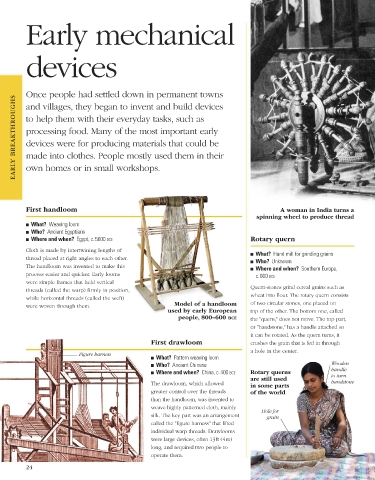
          First handloom                                                                     A woman in India turns a
                                                                                     spinning wheel to produce thread
          ■ ■ What?  Weaving loom
          ■ ■ Who?  Ancient Egyptians
          ■ ■ Where and when?  Egypt, c. 5000 bce                                  Rotary quern
          Cloth is made by intertwining lengths of
                                                                                   ■ ■ What?  Hand mill for grinding grains
          thread placed at right angles to each other.
                                                                                   ■ ■ Who?  Unknown
          The handloom was invented to make this
                                                                                   ■ ■ Where and when?  Southern Europe,
          process easier and quicker. Early looms                                    c. 600 bce
          were simple frames that held vertical
          threads (called the warp) firmly in position,                            Quern-stones grind cereal grains such as
          while horizontal threads (called the weft)                               wheat into flour. The rotary quern consists
          were woven through them.                        Model of a handloom      of two circular stones, one placed on
                                                        used by early European     top of the other. The bottom one, called
                                                           people, 800–600 bce     the “quern,” does not move. The top part,
                                                                                   or “handstone,” has a handle attached so
                                                                                   it can be rotated. As the quern turns, it
                                                  First drawloom                   crushes the grain that is fed in through
                                                                                   a hole in the center.
                           Figure harness
                                                  ■ ■ What?  Pattern weaving loom
                                                  ■ ■ Who?  Ancient Chinese                                  Wooden
                                                  ■ ■ Where and when?  China, c. 400 bce   Rotary querns     handle
                                                                                   are still used            to turn
                                                  The drawloom, which allowed      in some parts             handstone
                                                  greater control over the threads    of the world
                                                  than the handloom, was invented to
                                                  weave highly patterned cloth, mainly   Hole for
                                                  silk. The key part was an arrangement   grain
                                                  called the “figure harness” that lifted
                                                  individual warp threads. Drawlooms
                                                  were large devices, often 13 ft (4 m)
                                                  long, and required two people to
                                                  operate them.
          24


   US_024-025_Early_mechanical_devices_Gallery.indd   24                                                         08/03/18   3:09 PM

