


Page 27 - Inventions - A Visual Encyclopedia (DK - Smithsonian)
P. 27
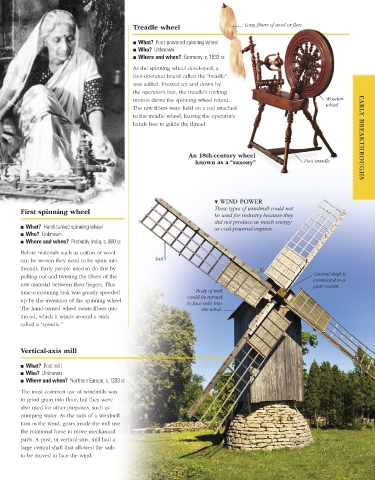
Treadle wheel                        Long fibers of wool or flax

                                            ■ ■ What?  Foot-powered spinning wheel
                                            ■ ■ Who?  Unknown
                                            ■ ■ Where and when?  Germany, c. 1533 ce
                                            As the spinning wheel developed, a
                                            foot-operated board called the “treadle”
                                            was added. Pressed up and down by
                                            the operator’s feet, the treadle’s rocking
                                            motion drove the spinning wheel round.                         Wooden
                                            The raw fibers were held on a rod attached                     wheel
                                            to the treadle wheel, leaving the operator’s
                                            hands free to guide the thread.                                            EARLY BREAKTHROUGHS


                                                               An 18th-century wheel
                                                                 known as a “saxony”                Foot treadle


                                                                       ▼ WIND POWER
        First spinning wheel                                           These types of windmill could not
                                                                       be used for industry because they
                                                                       did not produce as much energy
        ■ ■ What?  Hand-turned spinning wheel                          as coal-powered engines.
        ■ ■ Who?  Unknown
        ■ ■ Where and when?  Probably India, c. 600 ce
        Before materials such as cotton or wool
        can be woven they need to be spun into      Sail
        threads. Early people used to do this by
                                                                                                       Central shaft is
        pulling out and twisting the fibers of the
                                                                                                       connected to a
        raw material between their fingers. This                                                       gear system.
        time-consuming task was greatly speeded                  Body of mill
                                                              could be turned
        up by the invention of the spinning wheel.
                                                              to face sails into
        The hand-turned wheel twists fibers into                   the wind.
        thread, which it winds around a stick
        called a “spindle.”


        Vertical-axis mill

        ■ ■ What?  Post mill
        ■ ■ Who?  Unknown
        ■ ■ Where and when?  Northern Europe, c. 1200 ce
        The most common use of windmills was
        to grind grain into flour, but they were
        also used for other purposes, such as
        pumping water. As the sails of a windmill
        turn in the wind, gears inside the mill use
        the rotational force to move mechanical
        parts. A post, or vertical-axis, mill had a
        large central shaft that allowed the sails
        to be moved to face the wind.


   US_024-025_Early_mechanical_devices_Gallery.indd   25                                                         02/04/18   3:38 PM

