


Page 287 - Inventions - A Visual Encyclopedia (DK - Smithsonian)
P. 287
Weather         MARTIAN ROVERS
            Camera                 instruments
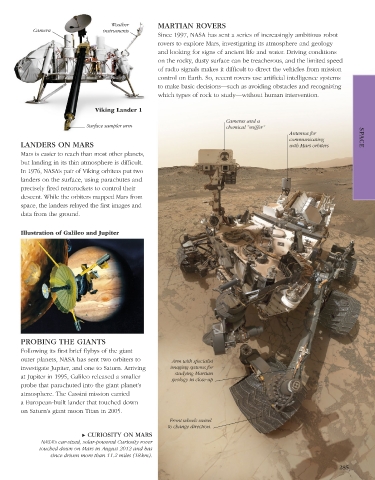
                                                     Since 1997, NASA has sent a series of increasingly ambitious robot
                                                     rovers to explore Mars, investigating its atmosphere and geology
                                                     and looking for signs of ancient life and water. Driving conditions
                                                     on the rocky, dusty surface can be treacherous, and the limited speed
                                                     of radio signals makes it difficult to direct the vehicles from mission
                                                     control on Earth. So, recent rovers use artificial intelligence systems
                                                     to make basic decisions—such as avoiding obstacles and recognizing
                                                     which types of rock to study—without human intervention.

                                Viking Lander 1
                                                                           Cameras and a
                             Surface sampler arm                           chemical “sniffer”
                                                                                               Antenna for
                                                                                               communicating           SPACE
        LANDERS ON MARS                                                                        with Mars orbiters
        Mars is easier to reach than most other planets,
        but landing in its thin atmosphere is difficult.
        In 1976, NASA’s pair of Viking orbiters put two
        landers on the surface, using parachutes and
        precisely fired retrorockets to control their
        descent. While the orbiters mapped Mars from
        space, the landers relayed the first images and
        data from the ground.


        Illustration of Galileo and Jupiter


        PROBING THE GIANTS
        Following its first brief flybys of the giant
        outer planets, NASA has sent two orbiters to     Arm with specialist
        investigate Jupiter, and one to Saturn. Arriving   imaging systems for
                                                          studying Martian
        at Jupiter in 1995, Galileo released a smaller
                                                         geology in close-up
        probe that parachuted into the giant planet’s
        atmosphere. The Cassini mission carried
        a European-built lander that touched down
        on Saturn’s giant moon Titan in 2005.
                                                        Front wheels swivel
                                                        to change direction.
                            ▶ CURIOSITY ON MARS
              NASA’s car-sized, solar-powered Curiosity rover
              touched down on Mars in August 2012 and has
                 since driven more than 11.2 miles (18 km).
                                                                                                                285


   US_284-285_Robotic_probes_Main.indd   285                                                                     08/03/18   3:10 PM

