


Page 289 - Inventions - A Visual Encyclopedia (DK - Smithsonian)
P. 289
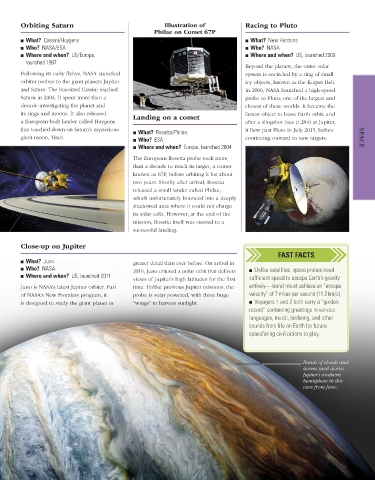
Orbiting Saturn                                Illustration of           Racing to Pluto
                                                   Philae on Comet 67P
        ■ ■ What?  Cassini/Huygens                                               ■ ■ What?  New Horizons
        ■ ■ Who?  NASA/ESA                                                       ■ ■ Who?  NASA
        ■ ■ Where and when?  US/Europe,                                          ■ ■ Where and when?  US, launched 2006
          launched 1997
                                                                                 Beyond the planets, the outer solar
        Following its early flybys, NASA launched                                system is encircled by a ring of small
        orbiter probes to the giant planets Jupiter                              icy objects, known as the Kuiper Belt.
        and Saturn. The bus-sized Cassini reached                                In 2006, NASA launched a high-speed
        Saturn in 2004. It spent more than a                                     probe to Pluto, one of the largest and
        decade investigating the planet and                                      closest of these worlds. It became the
        its rings and moons. It also released    Landing on a comet              fastest object to leave Earth orbit, and
        a European-built lander called Huygens                                   after a slingshot (see p.284) at Jupiter,
        that touched down on Saturn’s mysterious                                 it flew past Pluto in July 2015, before
                                            ■ ■ What?  Rosetta/Philae
        giant moon, Titan.                                                       continuing onward to new targets.     SPACE
                                            ■ ■ Who?  ESA
                                            ■ ■ Where and when?  Europe, launched 2004
                                            The European Rosetta probe took more
                                            than a decade to reach its target, a comet
                                            known as 67P, before orbiting it for about
                                            two years. Shortly after arrival, Rosetta
                                            released a small lander called Philae,
                                            which unfortunately bounced into a deeply
                                            shadowed area where it could not charge
                                            its solar cells. However, at the end of the
                                            mission, Rosetta itself was steered to a
                                            successful landing.

        Close-up on Jupiter
                                                                                            FAST FACTS
        ■ ■ What?  Juno                     greater detail than ever before. On arrival in
        ■ ■ Who?  NASA                      2016, Juno entered a polar orbit that delivers   ■ ■ Unlike satellites, space probes need
        ■ ■ Where and when?  US, launched 2011                                    sufficient speed to escape Earth’s gravity
                                            views of Jupiter’s high latitudes for the first
        Juno is NASA’s latest Jupiter orbiter. Part    time. Unlike previous Jupiter missions, the   entirely—launch must achieve an “escape
        of NASA’s New Frontiers program, it    probe is solar powered, with three huge   velocity” of 7 miles per second (11.2 km/s).
        is designed to study the giant planet in   “wings” to harvest sunlight.   ■ ■ Voyagers 1 and 2 both carry a “golden
                                                                                  record” containing greetings in various
                                                                                  languages, music, birdsong, and other
                                                                                  sounds from life on Earth for future
                                                                                  spacefaring civilizations to play.


                                                                                                    Bands of clouds and
                                                                                                    storms swirl across
                                                                                                    Jupiter’s southern
                                                                                                    hemisphere in this
                                                                                                    view from Juno.


   US_286-287_Pushing_the_boundaries_Gallery.indd   287                                                          09/03/18   4:06 PM

