


Page 286 - Inventions - A Visual Encyclopedia (DK - Smithsonian)
P. 286
Steering
          microjets                        Robotic probes
          Solar
          cells

                                           Human exploration of space has so far been limited
                                           to Earth orbit, but space agencies have sent dozens

                                           of automated space probes to explore planets, moons,
                                           comets, and asteroids. Flyby missions offer a brief glimpse

                                           of these objects, orbiters carry out more detailed surveys,
                                           and landers and rovers touch down on the surface to
            Camera
      SPACE  window                        measure conditions and analyze rocks.

                                     Communications
                                     antennae
                                                                                     THE VENERA MISSIONS
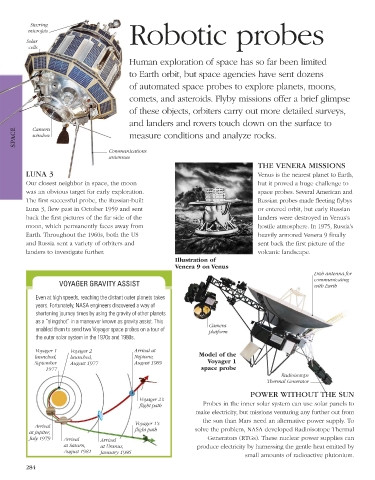
          LUNA 3                                                                     Venus is the nearest planet to Earth,

          Our closest neighbor in space, the moon                                    but it proved a huge challenge to
          was an obvious target for early exploration.                               space probes. Several American and
          The first successful probe, the Russian-built                              Russian probes made fleeting flybys
          Luna 3, flew past in October 1959 and sent                                 or entered orbit, but early Russian
          back the first pictures of the far side of the                             landers were destroyed in Venus’s
          moon, which permanently faces away from                                    hostile atmosphere. In 1975, Russia’s
          Earth. Throughout the 1960s, both the US                                   heavily armored Venera 9 finally
          and Russia sent a variety of orbiters and                                  sent back the first picture of the
          landers to investigate further.                                            volcanic landscape.
                                                          Illustration of
                                                          Venera 9 on Venus
                                                                                                        Dish antenna for
                                                                                                        communicating
                    VOYAGER GRAVITY ASSIST                                                              with Earth

             Even at high speeds, reaching the distant outer planets takes
             years. Fortunately, NASA engineers discovered a way of
             shortening journey times by using the gravity of other planets
             as a “slingshot” in a maneuver known as gravity assist. This
             enabled them to send two Voyager space probes on a tour of   Camera
                                                                     platform
             the outer solar system in the 1970s and 1980s.

             Voyager 1   Voyager 2           Arrival at
            launched,   launched,            Neptune,             Model of the
            September   August 1977          August 1989             Voyager 1
                1977                                               space probe
                                                                                             Radioisotope
                                                                                        Thermal Generator

                                                                                   POWER WITHOUT THE SUN
                                               Voyager 2’s
                                               flight path         Probes in the inner solar system can use solar panels to
                                                                 make electricity, but missions venturing any further out from
                                                                   the sun than Mars need an alternative power supply. To
                                             Voyager 1’s
            Arrival                                              solve the problem, NASA developed Radioisotope Thermal
           at Jupiter,                       flight path
           July 1979  Arrival     Arrival                            Generators (RTGs). These nuclear power supplies can
                      at Saturn,   at Uranus,                    produce electricity by harnessing the gentle heat emitted by
                      August 1981  January 1986
                                                                                 small amounts of radioactive plutonium.
          284


   US_284-285_Robotic_probes_Main.indd   284                                                                     08/03/18   3:10 PM

