


Page 33 - Inventions - A Visual Encyclopedia (DK - Smithsonian)
P. 33
A piece of a mineral called
                                                    pyrite created the sparks
                                                    that fired the gun.
                                                                                          ▼ HOW IT WORKS
                                                                                          A wheel lock works by
                                                                                          rotating a steel wheel against
                                                                                          a sparking material, causing
                                                                                          friction and sparks that ignite
                                                                                          the gunpowder.
        Handgun

        ■ ■ What?  Pistol                   easier to shoot with. Once
        ■ ■ Who?  Unknown                   loaded, handguns could be
        ■ ■ Where and when?  Europe, 16th century  fired with one hand and also
        During the early 16th century, smaller   used while on horseback, but early
        firearms were developed. Although not    models could fire only a single shot    German                        EARLY BREAKTHROUGHS
        as accurate or powerful as longer-barreled   before they had to be reloaded.  wheel lock
        weapons, their smaller size made them                                       handgun, 1590


                                            Percussion cap


            Long barrel                     ■ ■ What?  Firearm with percussion cap  was pulled, it moved a part called the
                                            ■ ■ Who?  Unknown                    “hammer” that struck the percussion cap,
                                            ■ ■ Where and when?  US/northern Europe,    sparking off the gunpowder charge and
        Flintlock firearm                     c. 1820                            firing the ammunition.
                                            The percussion cap was a small metal
        ■ ■ What?  Musket with flintlock mechanism  cup filled with an explosive mixture of
        ■ ■ Who?  Unknown                   chemicals called “fulminate” and sealed   ▼ FIRING AWAY
        ■ ■ Where and when?  Northern Europe, c. 1550
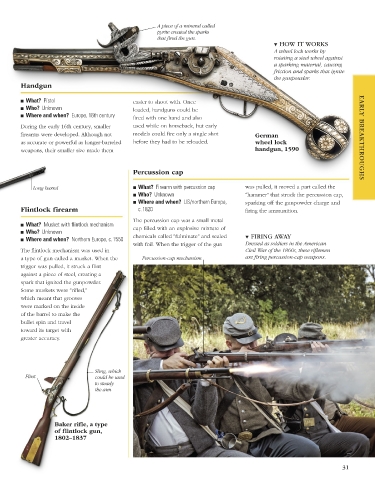
                                            with foil. When the trigger of the gun    Dressed as soldiers in the American
        The flintlock mechanism was used in                                      Civil War of the 1860s, these riflemen
        a type of gun called a musket. When the   Percussion-cap mechanism       are firing percussion-cap weapons.
        trigger was pulled, it struck a flint
        against a piece of steel, creating a
        spark that ignited the gunpowder.
        Some muskets were “rifled,”
        which meant that grooves
        were marked on the inside
        of the barrel to make the
        bullet spin and travel
        toward its target with
        greater accuracy.


                                Sling, which
         Flint                  could be used
                                to steady
                                the aim


                   Baker rifle, a type
                   of flintlock gun,
                   1802–1837


                                                                                                                 31


   US_030-031_Gunpowder_weapons_Gallery.indd   31                                                                08/03/18   6:37 PM

