


Page 35 - Inventions - A Visual Encyclopedia (DK - Smithsonian)
P. 35
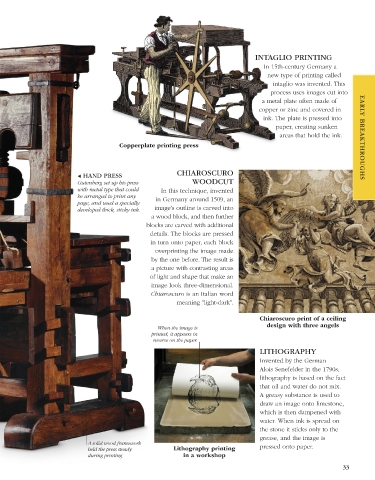
INTAGLIO PRINTING
                                                                                       In 15th-century Germany a
                                                                                        new type of printing called
                                                                                          intaglio was invented. This
                                                                                         process uses images cut into
                                                                                       a metal plate often made of
                                                                                      copper or zinc and covered in
                                                                                       ink. The plate is pressed into
                                                                                           paper, creating sunken
                                                                                            areas that hold the ink.   EARLY BREAKTHROUGHS
                                        Copperplate printing press


                                                           CHIAROSCURO
                          ◀ HAND PRESS
                          Gutenberg set up his press            WOODCUT
                          with metal type that could   In this technique, invented
                          be arranged to print any   in Germany around 1509, an
                          page, and used a specially
                          developed thick, sticky ink.  image’s outline is carved into
                                                  a wood block, and then further
                                                 blocks are carved with additional
                                                  details. The blocks are pressed
                                                  in turn onto paper, each block
                                                    overprinting the image made
                                                  by the one before. The result is
                                                  a picture with contrasting areas
                                                  of light and shape that make an
                                                  image look three-dimensional.
                                                  Chiaroscuro is an Italian word
                                                           meaning “light-dark”.

                                                                                      Chiaroscuro print of a ceiling
                                                                                        design with three angels
                                                    When the image is
                                                  printed, it appears in
                                                   reverse on the paper.
                                                                                      LITHOGRAPHY
                                                                                      Invented by the German
                                                                                      Alois Senefelder in the 1790s,
                                                                                      lithography is based on the fact
                                                                                      that oil and water do not mix.
                                                                                      A greasy substance is used to
                                                                                      draw an image onto limestone,
                                                                                      which is then dampened with
                                                                                      water. When ink is spread on
                                                                                      the stone it sticks only to the
                                                                                      grease, and the image is
                              A solid wood framework                                  pressed onto paper.
                              held the press steady       Lithography printing
                              during printing.               in a workshop
                                                                                                                 33


   US_032-033_The_printing_revolution_Main.indd   33                                                             08/03/18   3:09 PM

