


Page 37 - Inventions - A Visual Encyclopedia (DK - Smithsonian)
P. 37
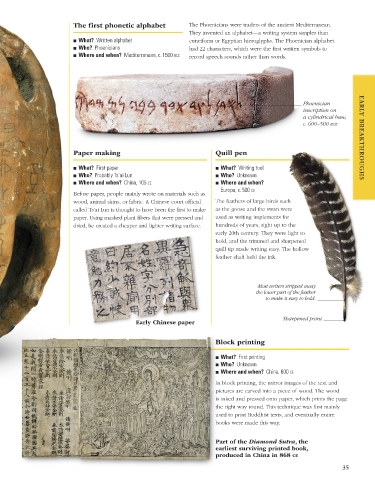
The first phonetic alphabet           The Phoenicians were traders of the ancient Mediterranean.
                                                               They invented an alphabet—a writing system simpler than
                         ■ ■ What?  Written alphabet           cuneiform or Egyptian hieroglyphs. The Phoenician alphabet
                         ■ ■ Who?  Phoenicians                 had 22 characters, which were the first written symbols to
                         ■ ■ Where and when?  Mediterranean, c. 1500 bce   record speech sounds rather than words.


                                                                                                    Phoenician
                                                                                                    inscription on
                                                                                                    a cylindrical base,
                                                                                                    c. 600–500 bce     EARLY BREAKTHROUGHS


                         Paper making                                  Quill pen


                         ■ ■ What?  First paper                        ■ ■ What?  Writing tool
                         ■ ■ Who?  Probably Ts’ai Lun                  ■ ■ Who?  Unknown
                         ■ ■ Where and when?  China, 105 ce            ■ ■ Where and when?
                                                                         Europe, c. 500 ce
                         Before paper, people mainly wrote on materials such as
                         wood, animal skins, or fabric. A Chinese court official   The feathers of large birds such
                         called Ts’ai Lun is thought to have been the first to make   as the goose and the swan were
                         paper. Using mashed plant fibers that were pressed and   used as writing implements for
                         dried, he created a cheaper and lighter writing surface.  hundreds of years, right up to the
                                                                       early 20th century. They were light to
                                                                       hold, and the trimmed and sharpened
                                                                       quill tip made writing easy. The hollow
                                                                       feather shaft held the ink.


                                                                                     Most writers stripped away
                                                                                     the lower part of the feather
                                                                                        to make it easy to hold.


                                                                                             Sharpened point
                                             Early Chinese paper


                                                                       Block printing

                                                                       ■ ■ What?  First printing
                                                                       ■ ■ Who?  Unknown
                                                                       ■ ■ Where and when?  China, 600 ce
                                                                       In block printing, the mirror images of the text and
                                                                       pictures are carved into a piece of wood. The wood
                                                                       is inked and pressed onto paper, which prints the page
                                                                       the right way round. This technique was first mainly
                                                                       used to print Buddhist texts, and eventually entire
                                                                       books were made this way.

                                                                       Part of the Diamond Sutra, the
                                                                       earliest surviving printed book,
                                                                       produced in China in 868 ce
                                                                                                                 35


   US_034-035_Writing_and_Printing_Gallery.indd   35                                                             08/03/18   3:09 PM

