


Page 54 - Inventions - A Visual Encyclopedia (DK - Smithsonian)
P. 54
Industrialization


          Between about 1750 and 1850, Britain transformed                                 WOW!

          itself from an agricultural nation into the world’s                      Not everyone welcomed the
          top industrial power. Cloth making was its most                         Industrial Revolution: Luddites
      MAKING THE MODERN WORLD  new machines were powered by steam—a period
                                                                                   were workers who destroyed
          profitable enterprise. At this time, many workers
                                                                                   machinery to protest change.
          moved from farms into the new factories, where


          known as the Industrial Revolution.


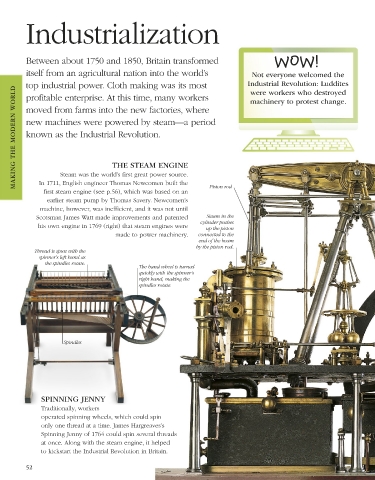
                                      THE STEAM ENGINE
                     Steam was the world’s first great power source.
              In 1711, English engineer Thomas Newcomen built the
               first steam engine (see p.56), which was based on an     Piston rod
                earlier steam pump by Thomas Savery. Newcomen’s
              machine, however, was inefficient, and it was not until
             Scotsman James Watt made improvements and patented     Steam in the
                                                                  cylinder pushes
             his own engine in 1769 (right) that steam engines were
                                                                    up the piston
                                       made to power machinery.   connected to the
                                                                  end of the beam
                                                                 by the piston rod.
            Thread is spun with the
              spinner’s left hand as
                the spindles rotate.
                                              The hand wheel is turned
                                              quickly with the spinner’s
                                              right hand, making the
                                              spindles rotate.


                      Spindles


              SPINNING JENNY
              Traditionally, workers
              operated spinning wheels, which could spin
              only one thread at a time. James Hargreaves’s
              Spinning Jenny of 1764 could spin several threads
              at once. Along with the steam engine, it helped
              to kickstart the Industrial Revolution in Britain.

          52


   US_052-053_308121_Industrialisation.indd   52                                                                 08/03/2018   17:17

