


Page 58 - Inventions - A Visual Encyclopedia (DK - Smithsonian)
P. 58
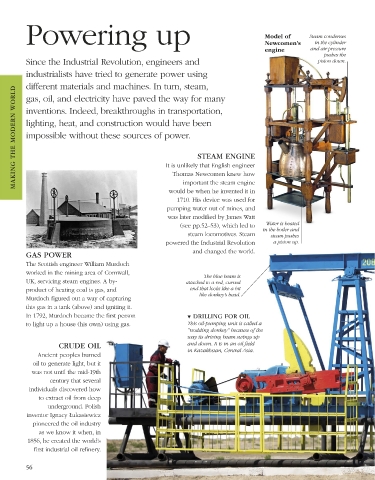
Powering up                                                                   Model of      Steam condenses


                                                                                                        in the cylinder
                                                                                        Newcomen’s
                                                                                        engine        and air pressure
                                                                                                           pushes the
          Since the Industrial Revolution, engineers and                                                 piston down.
          industrialists have tried to generate power using

          different materials and machines. In turn, steam,
      MAKING THE MODERN WORLD  lighting, heat, and construction would have been
          gas, oil, and electricity have paved the way for many

          inventions. Indeed, breakthroughs in transportation,


          impossible without these sources of power.


                                                                  STEAM ENGINE
                                                       It is unlikely that English engineer
                                                         Thomas Newcomen knew how
                                                             important the steam engine
                                                        would be when he invented it in
                                                           1710. His device was used for
                                                        pumping water out of mines, and
                                                        was later modified by James Watt
                                                            (see pp.52–53), which led to   Water is heated
                                                                                       in the boiler and
                                                              steam locomotives. Steam   steam pushes
                                                       powered the Industrial Revolution   a piston up.
          GAS POWER                                             and changed the world.
          The Scottish engineer William Murdoch
          worked in the mining area of Cornwall,
                                                                    The blue beam is
          UK, servicing steam engines. A by-                  attached to a red, curved
          product of heating coal is gas, and                  end that looks like a bit
                                                                  like donkey’s head.
          Murdoch figured out a way of capturing
          this gas in a tank (above) and igniting it.
          In 1792, Murdoch became the first person            ▼ DRILLING FOR OIL
          to light up a house (his own) using gas.            This oil-pumping unit is called a
                                                              “nodding donkey” because of the
                                                              way its driving beam swings up
                    CRUDE OIL                                 and down. It is in an oil field
                                                              in Kazakhstan, Central Asia.
             Ancient peoples burned
            oil to generate light, but it
           was not until the mid-19th
                 century that several
           individuals discovered how
              to extract oil from deep
                 underground. Polish
          inventor Ignacy Łukasiewicz
            pioneered the oil industry
              as we know it when, in
          1856, he created the world’s
            first industrial oil refinery.

          56


   US_056-057_308121_Power.indd   56                                                                             08/03/2018   17:17

