


Page 59 - Inventions - A Visual Encyclopedia (DK - Smithsonian)
P. 59
PUBLIC ELECTRICITY SUPPLY
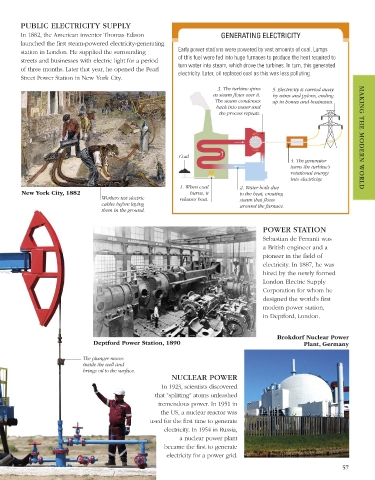
        In 1882, the American inventor Thomas Edison                     GENERATING ELECTRICITY
        launched the first steam-powered electricity-generating
        station in London. He supplied the surrounding     Early power stations were powered by vast amounts of coal. Lumps
        streets and businesses with electric light for a period    of this fuel were fed into huge furnaces to produce the heat required to
        of three months. Later that year, he opened the Pearl   turn water into steam, which drove the turbines. In turn, this generated
                                                           electricity. Later, oil replaced coal as this was less polluting.
        Street Power Station in New York City.

                                                                        3. The turbine spins    5. Electricity is carried away
                                                                       as steam flows over it.   by wires and pylons, ending
                                                                       The steam condenses   up in homes and businesses.
                                                                        back into water and
                                                                         the process repeats.


                                                           Coal                                                        MAKING THE MODERN WORLD
                                                                                                4. The generator
                                                                                                turns the turbine’s
                                                                                                rotational energy
                                                                                                into electricity.
                                                            1. When coal       2. Water boils due
        New York City, 1882                                    burns, it       to the heat, creating
                                  Workers test electric     releases heat.     steam that flows
                                  cables before laying                         around the furnace.
                                  them in the ground.


                                                                                       POWER STATION
                                                                                       Sebastian de Ferranti was
                                                                                       a British engineer and a
                                                                                       pioneer in the field of
                                                                                       electricity. In 1887, he was
                                                                                       hired by the newly formed
                                                                                       London Electric Supply
                                                                                       Corporation for whom he
                                                                                       designed the world’s first
                                                                                       modern power station,
                                                                                       in Deptford, London.


                                                                                            Brokdorf Nuclear Power
                                Deptford Power Station, 1890                                        Plant, Germany

                            The plunger moves
                            inside the well and
                            brings oil to the surface.
                                                         NUCLEAR POWER
                                                      In 1923, scientists discovered
                                                    that “splitting” atoms unleashed
                                                     tremendous power. In 1951 in
                                                      the US, a nuclear reactor was
                                                  used for the first time to generate
                                                       electricity. In 1954 in Russia,
                                                            a nuclear power plant
                                                       became the first to generate
                                                       electricity for a power grid.
                                                                                                                 57


   US_056-057_308121_Power.indd   57                                                                             08/03/2018   17:17

