


Page 65 - Inventions - A Visual Encyclopedia (DK - Smithsonian)
P. 65
BAKELITE
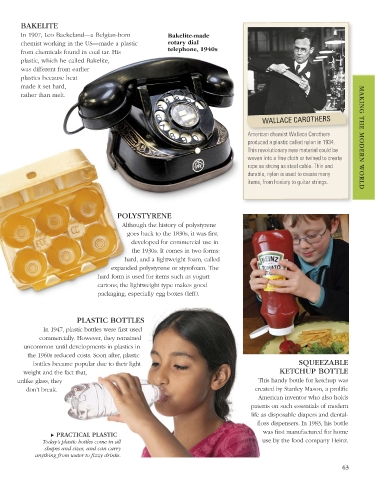
        In 1907, Leo Baekeland—a Belgian-born           Bakelite-made
        chemist working in the US—made a plastic        rotary dial
        from chemicals found in coal tar. His           telephone, 1940s
        plastic, which he called Bakelite,
        was different from earlier
        plastics because heat
        made it set hard,
        rather than melt.


                                                                                       WALLACE CAROTHERS

                                                                                  American chemist Wallace Carothers   MAKING THE MODERN WORLD
                                                                                  produced a plastic called nylon in 1934.
                                                                                  This revolutionary new material could be
                                                                                  woven into a fine cloth or twined to create
                                                                                  rope as strong as steel cable. Thin and
                                                                                  durable, nylon is used to create many
                                                                                  items, from hosiery to guitar strings.


                                       POLYSTYRENE
                                         Although the history of polystyrene
                                          goes back to the 1830s, it was first
                                            developed for commercial use in
                                            the 1930s. It comes in two forms:
                                          hard, and a lightweight foam, called
                                     expanded polystyrene or styrofoam. The
                                 hard form is used for items such as yogurt
                                 cartons; the lightweight type makes good
                                 packaging, especially egg boxes (left).


                          PLASTIC BOTTLES
               In 1947, plastic bottles were first used
              commercially. However, they remained
         uncommon until developments in plastics in
          the 1960s reduced costs. Soon after, plastic
            bottles became popular due to their light                                              SQUEEZABLE
         weight and the fact that,                                                          KETCHUP BOTTLE
       unlike glass, they                                                            This handy bottle for ketchup was
          don’t break.                                                              created by Stanley Mason, a prolific
                                                                                     American inventor who also holds
                                                                                   patents on such essentials of modern
                                                                                   life as disposable diapers and dental-
                                                                                     floss dispensers. In 1983, his bottle
                                                                                       was first manufactured for home
                  ▶ PRACTICAL PLASTIC
               Today’s plastic bottles come in all                                     use by the food company Heinz.
                shapes and sizes, and can carry
            anything from water to fizzy drinks.
                                                                                                                 63


   US_062-063_308121_Plastics.indd   63                                                                          08/03/2018   17:17

