


Page 67 - Inventions - A Visual Encyclopedia (DK - Smithsonian)
P. 67
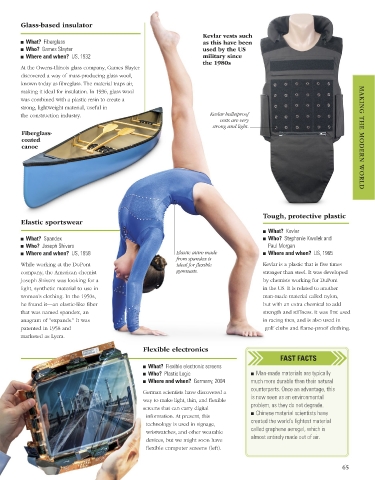
Glass-based insulator

                                                                   Kevlar vests such
        ■ ■ What?  Fiberglass                                      as this have been
        ■ ■ Who?  Games Slayter                                    used by the US
        ■ ■ Where and when?  US, 1932                              military since
                                                                   the 1980s
        At the Owens-Illinois glass company, Games Slayter
        discovered a way of mass-producing glass wool,
        known today as fibreglass. The material traps air,
        making it ideal for insulation. In 1936, glass wool
        was combined with a plastic resin to create a
        strong, lightweight material, useful in
        the construction industry.                                    Kevlar bulletproof
                                                                         vests are very
                                                                      strong and light.
        Fiberglass-
        coated                                                                                                         MAKING THE MODERN WORLD
        canoe


                                                                                       Tough, protective plastic
        Elastic sportswear

                                                                                       ■ ■ What?  Kevlar
        ■ ■ What?  Spandex                                                             ■ ■ Who?  Stephanie Kwolek and
        ■ ■ Who?  Joseph Shivers                                                         Paul Morgan
        ■ ■ Where and when?  US, 1958                      Elastic attire made         ■ ■ Where and when?  US, 1965
                                                           from spandex is
        While working at the DuPont                        ideal for flexible          Kevlar is a plastic that is five times
        company, the American chemist                      gymnasts.                   stronger than steel. It was developed
        Joseph Shivers was looking for a                                               by chemists working for DuPont
        light, synthetic material to use in                                            in the US. It is related to another
        women’s clothing. In the 1950s,                                                man-made material called nylon,
        he found it—an elastic-like fiber                                              but with an extra chemical to add
        that was named spandex, an                                                     strength and stiffness. It was first used
        anagram of “expands.” It was                                                   in racing tires, and is also used in
        patented in 1958 and                                                            golf clubs and flame-proof clothing.
        marketed as Lycra.
                                                Flexible electronics
                                                                                             FAST FACTS
                                                ■ ■ What?  Flexible electronic screens
                                                ■ ■ Who?  Plastic Logic            ■ ■ Man-made materials are typically
                                                ■ ■ Where and when?  Germany, 2004   much more durable than their natural
                                                                                   counterparts. Once an advantage, this
                                                German scientists have discovered a
                                                way to make light, thin, and flexible   is now seen as an environmental
                                                screens that can carry digital     problem, as they do not degrade.
                                                 information. At present, this     ■ ■ Chinese material scientists have
                                                 technology is used in signage,    created the world’s lightest material
                                                 wristwatches, and other wearable   called graphene aerogel, which is
                                                 devices, but we might soon have   almost entirely made out of air.
                                                 flexible computer screens (left).

                                                                                                                 65


   US_064-065_Man-made_materials.indd   65                                                                       09/03/2018   12:11

