


Page 66 - Inventions - A Visual Encyclopedia (DK - Smithsonian)
P. 66
Man-made                                                                                       Kitchen tiles


          materials


      MAKING THE MODERN WORLD  for hunting or cooking, for example—from natural    Hardy floor covering
          Since ancient times, we have made items—used


          materials such as stone, clay, and wood. In the
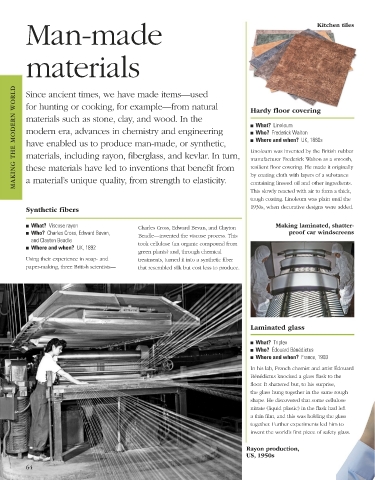
                                                                                    ■ What?  Linoleum
                                                                                   ■
          modern era, advances in chemistry and engineering
                                                                                    ■ Who?  Frederick Walton
                                                                                   ■
                                                                                    ■ Where and when?  UK, 1860s
                                                                                   ■
          have enabled us to produce man-made, or synthetic,
                                                                                   Linoleum was invented by the British rubber
          materials, including rayon, fiberglass, and kevlar. In turn,
                                                                                   manufacturer Frederick Walton as a smooth,
          these materials have led to inventions that benefit from
                                                                                   resilient floor covering. He made it originally
                                                                                   by coating cloth with layers of a substance
          a material’s unique quality, from strength to elasticity.
                                                                                   containing linseed oil and other ingredients.
                                                                                   This slowly reacted with air to form a thick,
                                                                                   tough coating. Linoleum was plain until the
          Synthetic fibers                                                         1930s, when decorative designs were added.

          ■ ■ What?  Viscose rayon            Charles Cross, Edward Bevan, and Clayton     Making laminated, shatter-
          ■ ■ Who?  Charles Cross, Edward Bevan,    Beadle—invented the viscose process. This   proof car windscreens
            and Clayton Beadle                took cellulose (an organic compound from
          ■ ■ Where and when?  UK, 1892
                                              green plants) and, through chemical
          Using their experience in soap- and   treatments, turned it into a synthetic fiber
          paper-making, three British scientists—   that resembled silk but cost less to produce.


                                                                                   Laminated glass


                                                                                   ■ ■ What?  Triplex
                                                                                   ■ ■ Who?  Édouard Bénédictus
                                                                                   ■ ■ Where and when?  France, 1903
                                                                                   In his lab, French chemist and artist Édouard
                                                                                   Bénédictus knocked a glass flask to the
                                                                                   floor. It shattered but, to his surprise,
                                                                                   the glass hung together in the same rough
                                                                                   shape. He discovered that some cellulose
                                                                                   nitrate (liquid plastic) in the flask had left
                                                                                   a thin film, and this was holding the glass
                                                                                   together. Further experiments led him to
                                                                                   invent the world’s first piece of safety glass.


                                                                                 Rayon production,
                                                                                 US, 1950s
          64


   US_064-065_Man-made_materials.indd   64                                                                       08/03/2018   17:17

