


Page 71 - Inventions - A Visual Encyclopedia (DK - Smithsonian)
P. 71
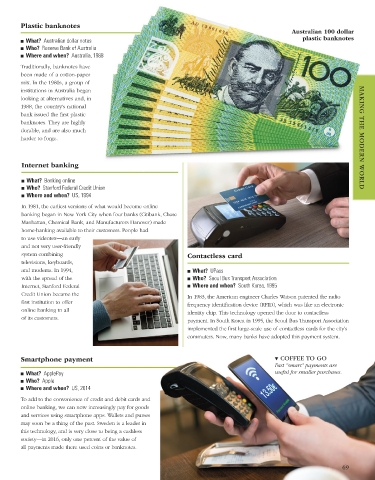
Plastic banknotes
                                                                                                Australian 100 dollar
        ■ ■ What?  Australian dollar notes                                                          plastic banknotes
        ■ ■ Who?  Reserve Bank of Australia
        ■ ■ Where and when?  Australia, 1988
        Traditionally, banknotes have
        been made of a cotton-paper
        mix. In the 1980s, a group of
        institutions in Australia began
        looking at alternatives and, in
        1988, the country’s national
        bank issued the first plastic
        banknotes. They are highly
        durable, and are also much
        harder to forge.                                                                                               MAKING THE MODERN WORLD


        Internet banking

        ■ ■ What?  Banking online
        ■ ■ Who?  Stanford Federal Credit Union
        ■ ■ Where and when?  US, 1994
        In 1981, the earliest versions of what would become online
        banking began in New York City when four banks (Citibank, Chase
        Manhattan, Chemical Bank, and Manufacturers Hanover) made
        home-banking available to their customers. People had
        to use videotex—an early
        and not very user-friendly
        system combining                                      Contactless card
        televisions, keyboards,
        and modems. In 1994,                                  ■ ■ What?  UPass
        with the spread of the                                ■ ■ Who?  Seoul Bus Transport Association
        Internet, Stanford Federal                            ■ ■ Where and when?  South Korea, 1995
        Credit Union became the
                                                              In 1983, the American engineer Charles Watson patented the radio
        first institution to offer
                                                              frequency identification device (RFID), which was like an electronic
        online banking to all
                                                              identity chip. This technology opened the door to contactless
        of its customers.
                                                              payment. In South Korea in 1995, the Seoul Bus Transport Association
                                                              implemented the first large-scale use of contactless cards for the city’s
                                                              commuters. Now, many banks have adopted this payment system.


        Smartphone payment                                                                 ▼ COFFEE TO GO
                                                                                           Fast “smart” payments are
        ■ ■ What?  ApplePay                                                                useful for smaller purchases.
        ■ ■ Who?  Apple
        ■ ■ Where and when?  US, 2014
        To add to the convenience of credit and debit cards and
        online banking, we can now increasingly pay for goods
        and services using smartphone apps. Wallets and purses
        may soon be a thing of the past. Sweden is a leader in
        this technology, and is very close to being a cashless
        society—in 2016, only one percent of the value of
        all payments made there used coins or banknotes.


                                                                                                                 69


   US_068-069_308121_Money.indd   69                                                                             08/03/2018   17:17

