


Page 44 - (DK Eyewitness) Travel Guide - Sweden
P. 44
42 INTRODUCING SWEDEN
Sweden’s Age of Greatness
For more than a century (1611–1721) Sweden was the
dominant power in northern Europe, and the Baltic was
effectively a Swedish inland sea. The country was at its most
powerful after the Peace of Roskilde in 1658, when Sweden
acquired seven new provinces. Outside today’s frontiers, the
Swedish Empire covered Finland, large parts of the Baltic
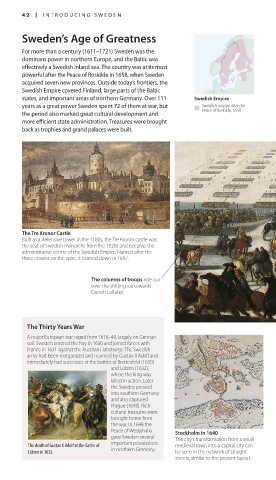
states, and important areas of northern Germany. Over 111 Swedish Empire
years as a great power Sweden spent 72 of them at war, but Sweden’s empire after the
Peace of Roskilde, 1658
the period also marked great cultural development and
more efficient state administration. Treasures were brought
back as trophies and grand palaces were built.
The Tre Kronor Castle
Built as a defensive tower in the 1180s, the Tre Kronor castle was
the seat of Swedish monarchs from the 1520s and became the
administrative centre of the Swedish Empire. Named after the
three crowns on the spire, it burned down in 1697.
The columns of troops ride out
over the shifting ice towards
Danish Lolland.
The Thirty Years War
A major European war raged from 1618–48, largely on German
soil. Sweden entered the fray in 1630 and joined forces with
France in 1631 against the Austrian Habsburgs. The Swedish
army had been reorganized and rearmed by Gustav II Adolf and
immediately had successes at the battles of Breitenfeld (1630)
and Lützen (1632),
where the king was
killed in action. Later
the Swedes pressed
into southern Germany
and also captured
Prague (1648). Rich
cultural treasures were
brought home from
the war. In 1648 the
Peace of Westphalia Stockholm in 1640
gave Sweden several The city’s transformation from a small
The death of Gustav II Adolf at the Battle of important possessions medieval town into a capital city can
Lützen in 1632 in northern Germany. be seen in the network of straight
streets, similar to the present layout.
042-SW-ED081-1096-History4.indd 42 22/07/13 4:06 PM
Eyewitness Travel LAYERS PRINTED:
Starsight history template “UK” LAYER
(Source v1)
Date 22nd October 2012
Size 125mm x 217mm

