


Page 236 - (DK) I Can’t Believe It! 2
P. 236
234
     Animal data


        LUMINOUS   ANIMALS   jellyfish emit a brilliant burst    of glow-worm (beetle larva) that can give off
                           Many scorpions are
                                                          Some click beetles emit a
                                                        bright light to ward off predators; their
                         fluorescent—they have
                         molecules on their body surface
                                                        light is so strong that you can read by it.
                         that glow in ultraviolet light
                                                          Railroad worms are a form
                         When attacked, Atolla
                                                       light in different colors; their head glows
                       of light that can be seen up to
                                                         red, while the body has green spots.
                       300 ft (91 m) away.
                                                            Sea sparkles (Noctiluca
                                                          scintillans) are tiny sea creatures
                         Comb jellies produce blue
                                                          that form huge colonies up to 80
                       or green light, but moving their body
                                                          miles (128 km) long. When disturbed,
                       can scatter the light to create
                                                          they flash blue-green phosphorescent
                       multicolored moving patterns.
                                                          light across miles of ocean.
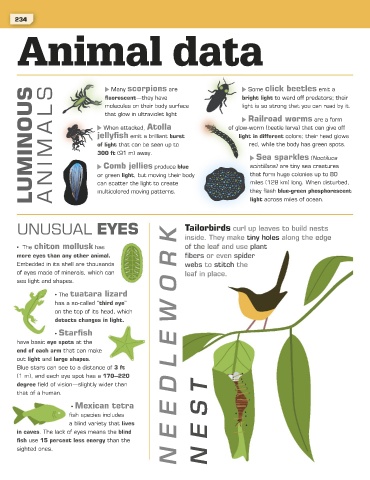
     UNUSUAL EYES                          Tailorbirds curl up leaves to build nests
                                           inside. They make tiny holes along the edge
     •  The chiton mollusk has             of the leaf and use plant
     more eyes than any other animal.      fibers or even spider
     Embedded in its shell are thousands   webs to stitch the
     of eyes made of minerals, which can   leaf in place.
     see light and shapes.
             • The tuatara lizard
             has a so-called “third eye”
             on the top of its head, which
             detects changes in light.
             • Starfish
     have basic eye spots at the         NEEDLEWORK
     end of each arm that can make
     out light and large shapes.
     Blue stars can see to a distance of 3 ft
     (1 m), and each eye spot has a 170–220
     degree field of vision—slightly wider than   T
     that of a human.
                  • Mexican tetra
                 fish species includes
                 a blind variety that lives     ES
     in caves. The lack of eyes means the blind
     fish use 15 percent less energy than the
     sighted ones.
                                                N


   US_234_235_309600_Animal_Data.indd   234                               19/12/17   3:48 pm

