


Page 309 - (DK) I Can’t Believe It! 2
P. 309
TRUE OR FALSE?  307
     Starlight is    find out which stars produce the most light by   FAST FACTS
                     Stars produce different amounts of light. We
                    comparing their luminosity—the energy a star
                     emits in just one second. The brightest stars  THE HOTTEST STARS
 millions of years old  release more than six million times the light     ARE BLUE
                       of the sun, while the least luminous stars
                                                       You might expect the hottest stars
                           create less than one ten-thousandth.
                                                       to be red, and the coolest to be
                                                       blue, but in fact it’s the other
                                                       way around. Blue stars reach a
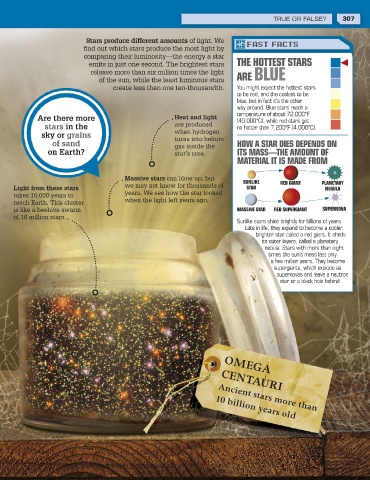
          Are there more                 Heat and light   temperature of about 72,000°F
                                                       (40,000°C), while red stars get
           stars in the                  are produced   no hotter than 7,200°F (4,000°C).
          sky or grains                  when hydrogen
             of sand                     turns into helium   HOW A STAR DIES DEPENDS ON
                                         gas inside the
            on Earth?                    star’s core.  ITS MASS—THE AMOUNT OF
                                                       MATERIAL IT IS MADE FROM
                             Massive stars can blow up, but    SUNLIKE    RED GIANT  PLANETARY
    Light from these stars   we may not know for thousands of   STAR       NEBULA
    takes 16,000 years to    years. We see how the star looked
    reach Earth. This cluster   when the light left years ago.
    is like a beehive swarm                            MASSIVE STAR  RED SUPERGIANT  SUPERNOVA
    of 10 million stars.
                                                       Sunlike stars shine brightly for billions of years.
                                                         Late in life, they expand to become a cooler,
                                                           brighter star called a red giant. It sheds
                                                            its outer layers, called a planetary
                                                             nebula. Stars with more than eight
                                                              times the sun’s mass last only
                                                              a few million years. They become
                                                               supergiants, which explode as
                                                                supernovas and leave a neutron
                                                                star or a black hole behind.


                                                    OMEGA
                                                   CENTAURI

                                                  Ancient stars more than
                                                  10 billion years old


   US_306-307_187013_Stars.indd   307                                     20/12/17   5:19 pm

