


Page 314 - (DK) I Can’t Believe It! 2
P. 314
312
     Out of this world


     A UNIVERSAL                                           Venus is the hottest planet in our
                                                           solar system. The surface is
                          VIEW                             hot enough to melt lead.


                                                                               500°C
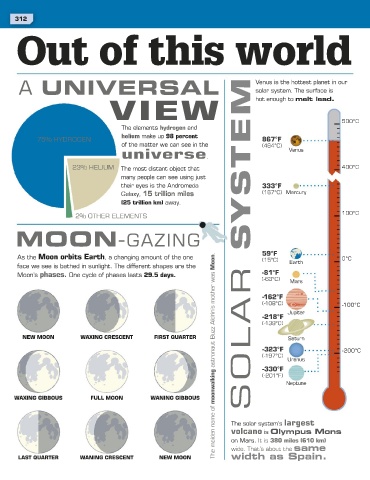
                             The elements hydrogen and
                             helium make up 98 percent
         75% HYDROGEN                                       867°F
                             of the matter we can see in the    (464°C)
                                                                   Venus
                             universe.
                 23% HELIUM  The most distant object that                      400°C
                            many people can see using just
                            their eyes is the Andromeda     333°F
                            Galaxy, 15 trillion miles       (167°C)  Mercury
                            (25 trillion km) away.                                         BLAST OFF!
                  2% OTHER ELEMENTS                                            100°C
     MOON-GAZING                                          SOLAR SYSTEM

                                                            59°F
                                                  The maiden name of moonwalking astronaut Buzz Aldrin’s mother was Moon.
     As the Moon orbits Earth, a changing amount of the one   (15°C)  Earth    0°C
     face we see is bathed in sunlight. The different shapes are the
     Moon’s phases. One cycle of phases lasts 29.5 days.    -81°F
                                                            (-63°C)  Mars                                    MAKING AN
                                                                                         IMPACT
                                                            -162°F                      IMPACT
                                                            (-108°C)           -100°C
                                                                  Jupiter
                                                            -218°F
                                                            (-139°C)
      NEW MOON     WAXING CRESCENT  FIRST QUARTER                 Saturn
                                                            -323°F             -200°C
                                                            (-197°C)
                                                                  Uranus
                                                            -330°F
                                                            (-201°F)
                                                                  Neptune
    WAXING GIBBOUS    FULL MOON    WANING GIBBOUS

                                                     The solar system’s largest
                                                     volcano is Olympus Mons             About 3,000 meteorites land on Earth every year—most burn up in the atmosphere.
                                                     on Mars. It is 380 miles (610 km)
                                                     wide. That’s about the same
     LAST QUARTER  WANING CRESCENT   NEW MOON        width as Spain.


   US_312_313_309600_TOF_Space.indd   312                                 20/12/17   5:31 pm

