


Page 14 - World of Animals - Issue #33
P. 14
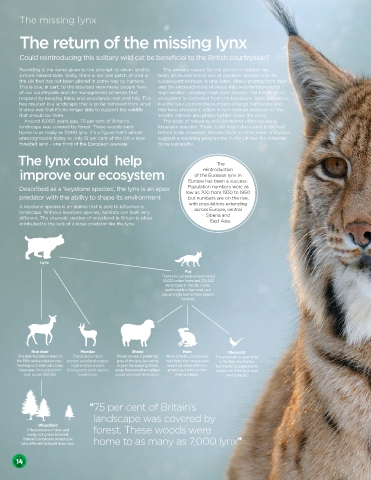
The missing lynx

            The return of the missing lynx


            Could reintroducing this solitary wild cat be beneficial to the British countryside?
            Rewilding is the name given to the attempt to return land to   The primary reason for the decline in habitat has
            a more natural state. Sadly, there is not one patch of land in   been attributed to the loss of predator species and the
            the UK that has not been altered in some way by humans.   subsequent increase in ungulates. Heavy grazing from deer
            This is due, in part, to the idealised view many people have   and the encroachment of sheep into woodland prevents
            of our countryside and the management schemes that   regeneration, creating large open spaces. The health of an
            respond by keeping fields and woodlands neat and tidy. This   ecosystem is controlled from the top down. Apex predators,

            has resulted in a landscape that is so far removed from what   like the lynx, control the numbers of large herbivores and
            it once was that it’s no longer able to support the wildlife   mid-level predators, which in turn relieves pressure on the
            that should be there.                            smaller animals and plants further down the chain.
              Around 6,000 years ago, 75 per cent of Britain’s   The topic of releasing wild carnivores often causes a
            landscape was covered by forest. These woods were   knee-jerk reaction. There is still much discussion to be had
            home to as many as 7,000 lynx. It’s a figure that’s almost   before trials. However, introductions in other areas of Europe

            unrecognisable today as only 13 per cent of the UK is now   suggest a rewilding programme in the UK has the potential
            forested land – one third of the European average.   to be successful.
            The lynx could  help                                                 The

                                                                             reintroduction
            improve our ecosystem                                         of the Eurasian lynx in
                                                                       Europe has been a success.
                                                                       Population numbers were as
            Described as a ‘keystone species’, the lynx is an apex     low as 700 from 1930 to 1950
            predator with the ability to shape its environment         but numbers are on the rise,
                                                                        with populations extending
            A keystone species is an animal that is able to influence a   across Europe, central

            landscape. Without keystone species, habitats can look very       Siberia and
            different. The dramatic decline of woodland in Britain is often    East Asia.
            attributed to the lack of a large predator like the lynx.


                   Lynx
                                                                      Fox
                                                              There are currently an estimated
                                                              33,000 urban foxes and 225,000
                                                               rural foxes in the UK. Foxes,
                                                               particularly urban ones, are
                                                              becoming braver in their search
                                                                     for food.


                Roe deer         Muntjac            Sheep            Hare            Pheasant
            Roe deer became extinct in   The large numbers   Sheep are not a preferred   While lynx do occasionally   The pheasant is again prey
           the 18th century due to over- prevent woodland coppice   prey of the lynx, but some   hunt hare, their population   to the lynx and the fox,
           hunting, but reintroductions   regeneration and are   argue that keeping sheep   would increase with lynx   but similarly, populations
            have seen their population   driving some plant species   away from woodland edges   around as the fox is their   would rise if the lynx  was
              soar to over 500,000.   to extinction.   would eliminate temptation.   main predator,  reintroduced.


                                     “75 per cent of Britain’s

                                      landscape was covered by
                   Woodland
               If the pressure of deer and   forest. These woods were
               overgrazing was relieved,
             Britain’s landscape would look   home to as many as 7,000 lynx”

             very different to how it does now.
           14

