


Page 19 - World of Animals - Issue #33
P. 19
B u t t e r fl i e s
Butterfl ies
W e’ v e had
We’ve had
butterfl ies
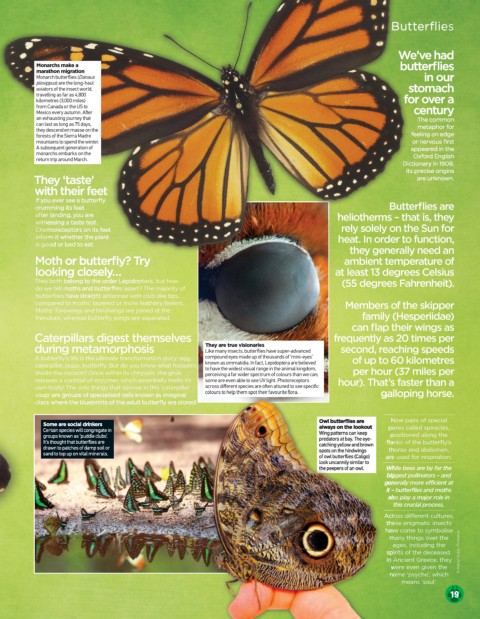
Monarchs make a butterfl ies
marathon migration
in our
Monarch butterflies (Danaus in our
plexippus) are the long-haul
stomach
aviators of the insect world, stomach
travelling as far as 4,800
for over a
kilometres (3,000 miles) for over a
century
from Canada or the US to century
Mexico every autumn. Aer
an exhausting journey that T h e c om m on
The common
can last as long as 75 days, metaphor for
t
a
or
ph
m
or
e
f
they descend en masse on the
n e
l
g
g o
e
n
i
d
e
e
forests of the Sierra Madre f feeling on edge
or nervous first
mountains to spend the winter. o r n e r v o u s fi r s t
A subsequent generation of ap pe ar e d i n t h e
appeared in the
monarchs embarks on the O x f o r d E n gl i sh
Oxford English
return trip around March.
D i c t i o n a r y i n 1 9 0 8 .
Dictionary in 1908.
r
i
e
c
n
i
g
s
I Its precise origins
t
e o
s
s p
i
r
s
te
’
a
ey
t
‘
T
h
They ‘taste’ ar e u nk n o w n .
are unknown.
with their feet
with their feet
u e
f
e
r
e
v
I If you ever see a butterfly
t
t
fl
e
y
y
o
e a b
u
r s
drumming its feet Butterfl ies are
e
i
s f
t
t
g i
d
e
n
r
m
u
m
g
ar
r
n
after landing, you are heliotherms – that is, they
a
y
e
heliotherms – that is, they
t
f
,
ou
and
i
e
l
w i t n ess i ng a tas t e t es t .
witnessing a taste test.
Ch e m or e c e p t ors on i t s f e e t rely solely on the Sun for
Chemoreceptors on its feet
e p
t
f
l
o
h
t
t w
i inform it whether the plant heat. In order to function,
e
h
r t
h
r
a
n
e
m i
n
t
a
o e
i is good or bad to eat..
o
s g
r b
a
d o
d t
o
they generally need an
M
y
y
Moth or butterfly? Try ambient temperature of
ut
? T
r
h
fl
ot
e
t
r
r b
o
looking closely… at least 13 degrees Celsius
looking closely…
u
l
e o
i
g t
n
p
w
d
, b
r
d
o
o
r
a
e
b
o
They both belong to the order Lepidoptera, but how (55 degrees Fahrenheit).
e
o t
p
t
e
h
t h
r L
e
t
i
e m
r
p
r
e
h
s a
? T
fl
a
l
d b
l m
i
o
do we tell moths and butterflies apart? The majority of
r
e
h
y o
t
f
t
n
s a
o
j
e
e t
t
t
o w
d
a
u
u
b
-
t
s
l
i
k
e t
l
p
h c
i
t
e
h
t a
r
t
n
t
i
t
r
a
v
a
e s
g
u
a
b
n
i
i
e
e w
s h
n
butterflies have straight antennae with club-like tips, ,
fl
e
c o m p a r e d t o m o t h s ’ t a p e r e d o r m o r e f e a t h e r y f e e l e r s . Members of the skipper
compared to moths’ tapered or more feathery feelers.
Moths’ forewings and hindwings are joined at the
frenulum, whereas butterfly wings are separated. family (Hesperiidae)
can flap their wings as
Caterpillars digest themselves frequently as 20 times per
during metamorphosis They are true visionaries second, reaching speeds
Like many insects, butterflies have super-advanced
A butterfly’s life is the ultimate transformation story: egg, compound eyes made up of thousands of ‘mini-eyes’ of up to 60 kilometres
caterpillar, pupa, butterfly. But do you know what happens known as ommatidia. In fact, Lepidoptera are believed
to have the widest visual range in the animal kingdom,
inside the cocoon? Once within its chrysalis, the grub perceiving a far wider spectrum of colours than we can; per hour (37 miles per
releases a cocktail of enzymes which essentially melts its some are even able to see UV light. Photoreceptors hour). That’s faster than a
own body! The only things that survive in this ‘caterpillar across different species are oen attuned to see specific
galloping horse.
ora.
colours to help them spot their favourite fl
e
e
’ a
c
p
i
s i
n
a
s
d c
i
o
w
e
o
u
l
n a
s
ro
soup’ are groups of specialised cells known as imaginal l colours to help them spot their favourite flora. galloping horse.
s k
a
u
e g
m
l
f s
r
g
s o
p
a
n
i
l
p
discs where the blueprints of the adult butterfly are stored.
d i s c s w h e r e t h e b l u e p r i n t s o f t h e a d u l t b u t t e r fl y a r e s t o r e d .
Nine pairs of special
erfl
ies ar
e
Owl butt
Owl butterflies are N i n e p a i r s o f s p e c i a l
Some ar
ers
e social drink
Some are social drinkers always on the lookout p o r e s c a l l e d s p i r a c l e s ,
always on the lookout
pores called spiracles,
Certain species will congregate in
Certain species will congregate in Wing patterns can keep
Wing patterns can keep
o
i
t
t
a
g
he
o
i
l
s
p
o
n
ned
groups known as ‘puddle clubs’.
groups known as ‘puddle clubs’. predators at bay. The eye- positioned along the
predators at bay. The eye-
s o
t
t
e
k
’
s
fl
h
It’s thought that butterflies are
e b
It’s thought that butterfl ies are catching yellow and brown flanks of the butterfly’s
a
n
fl
f t
u
r
y
catching yellow and brown
drawn to patches of damp soil or spots on the hindwings thorax and abdomen, ,
drawn to patches of damp soil or
x
n
bdo
a
a
d
e
r
m
t
n
ho
a
spots on the hindwings
sand to top up on vital minerals.
sand to top up on vital minerals. of owl butterfl ies (Caligo) a r e u s e d f o r r e s p i r a t i o n .
of owl butterflies (Caligo)
are used for respiration.
look uncannily similar to
look uncannily similar to
e
h
y f
s a
e
e b
r
W
h
i
l
r t
e
e b
a
the peepers of an owl.
the peepers of an owl. While bees are by far the
biggest pollinators – and
b i g ge st po l l i n a t o r s – a nd
generally more efficient at
g e ne rall y m o r e e f f i c i e n t a t
i it – butterflies and moths
s a
l
s
e
i
o
t
t
n
u
e
t
r
t – b
f
d m
h
also play a major role in
a l s o p l a y a m a j o r r o l e i n
o
p
ce
l
s
s
r
c
this crucial process..
uc
h
t
i
is
a
r
Ac ro s s d i f f e r e n t c u l t u r e s ,
Across different cultures,
ic
t
i
e
c
e
se
n
n
se
i
m
h
t these enigmatic insects
t
a
g
s
v
y
o
m
b
e
h have come to symbolise
o
o s
e c
a
e t
i
l
m
s
i
ove
a
m
many things over the
s
g
r
ny
t
e
n
t
h
h
e
h
ages, including the
ag
t
ng
,
c
i
d
n
i
lu
es
i
s o
d
p
s
e
f t
e
s spirits of the deceased. . © Alamy; Corbis; Thinkstock
e
e d
a
c
i
r
h
t
r
e
e
n
e
n A
t G
i
e
, t
c
y
c
In Ancient Greece, they
I
e
n
h
were even given the
w er e e v en g i v en t he
h
y
c
’
a
i
, w
m
h
e ‘
s
e
h
name ‘psyche’, which
c
n
p
means ‘soul’.
19 19

