


Page 18 - World of Animals - Issue #33
P. 18
18
Amazing
facts
s
u
e
t
B
Butterfl ies
t
e
fl i
r
fl
l a
l a
l a
u
fl
fl
o g
o g
e
o g
d t
d t
d t
e
l
l
l
t a
e
t a
t a
e
v
e
e
e
e
v
v
a
l
a
a
l
l
e
t
t
t
t
u
u
t
t
er a
e r
s w
e r
e r
er a
er a
s w
s w
a
e p
a
e p
a
e
p
p
p
e
e
r
e
Be prepared to get all aflutter as we reveal
e
r
e
r
r
r
e p
B B B
r
he s
l
o
l
t c
o
s
f
u
r
o
u
the secrets of some of the most colourful
e
e o
r
m
f s
s o
o
t
f t
c
the secrets of some of the most colourful
he m
e
t
characters in the animal kingdom
characters in the animal kingdom
Most butterfl
r
Most butterflies don’t survive F e m al e spe c i m e ns o f The European swallowtail
The European swallowtail
E
u
Female specimens of
al
op
e
w
n s
a
l
l
ies don’t survive
i
o
w
ta
beyond a month, but brimstones Queen Alexandra’s birdwing beyond a month, but brimstones Queen Alexandra’s birdwing (Papilio machaon) has (Papilio machaon) has Papilio machaon) has Papilio machaon
(Gonepteryx rhamni) are an (Gonepteryx rhamni(Gonepteryx rhamni(Gonepteryx rhamni) are an Gonepteryx rhamni ) are an ( ( ( the slowest recorded
(Ornithoptera alexandrae), Ornithoptera alexandraeOrnithoptera alexandrae), Ornithoptera alexandrae), Ornithoptera alexandrae
the slowest recorded
exception. They often live for
exception. They often live for have been recorded with wingbeat of any insect in
wingbeat of any insect in
have been recorded with
wings spanning as wide as 28 the world, flapping as few
12-13 months by avoiding poor
12-13 months by avoiding poor wings spanning as wide as 28 the world, fl apping as few
as five times per second.
ve times per second.
centimetres (11 inches).
weather through hibernation. centimetres (11 inches). as fi
weather through hibernation.
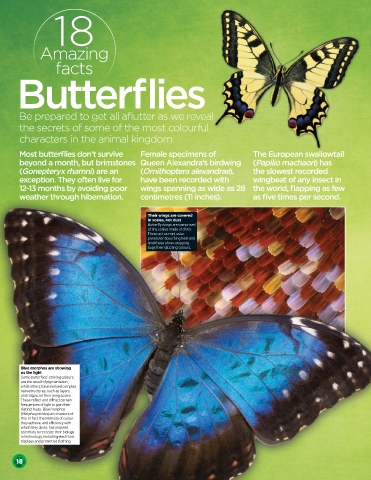
Their wings are covered
in scales, not dust
Butterfly wings are comprised
of tiny scales made of chitin.
These act as mini solar
panels for absorbing heat and
lend these show-stopping
bugs their dazzling colours.
Blue morphos are showing
us the light
Some butterflies’ striking colours
are the result of pigmentation,
while others have evolved complex
nanostructures, such as layers
and ridges, on their wing scales.
These reflect and diffract certain
frequencies of light to gain their
distinct hues. Blue morphos
(Morpho peleides) are masters of
this. In fact, the intensity of colour
they achieve, and effi ciency with
which they do so, has inspired
scientists to recreate their biology
in technology, including electronic
displays and protective clothing.
18 18 18 18

