


Page 46 - World of Animals - Issue #36
P. 46
The burrowers

            A molehill                                        Moles can survive for long

                                                              periods underground thanks to
                                                              specialised blood cells
            Moles live secret lives underground

            thanks to their terrific tunnelling skills
            Everything about moles is adapted to a life spent
            underground. Their powerful front legs and paws help

            them to dig tunnels efficiently, propelling them through
            the dirt in a swift swimming motion. To compensate for
            poor visibility, a mole’s snout is able to smell in stereo –
            each nostril works independently, detecting subterranean
            morsels like earthworms with impressive accuracy. Even
            the mole’s blood cells are designed with burrowing in mind
            – these contain special haemoglobin proteins, allowing the
            animal to reuse oxygen inhaled above ground.
              As they spend so much time underground, most people
            have never seen a mole in the wild. Yet almost everyone
            has seen a molehill. These mounds of dirt are comprised
            of the excess soil excavated by moles digging and
            repairing tunnels.
              Gardeners and farmers may find them a nuisance, but

            moles play an important role in aerating and tilling soil,
            making it more fertile. As such, dirt taken from molehills
            makes excellent potting soil.


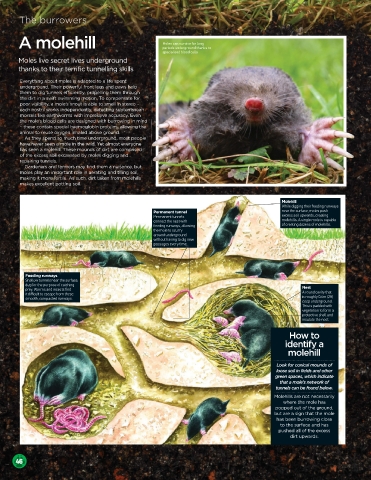
                                                                                                        Molehill
                                                                                                        Molehill
                                                                                                        While digging their feeding runways
                                                                                                        While digging their feeding runways
                                                           Permanent tunnel                             near the surface, moles push
                                                           Permanent tunnels                            excess soil upwards, creating
                                                           connect the nest with                        molehills. A single mole is capable
                                                           feeding runways, allowing                    of creating dozens of molehills.
                                                           the mole to scurry
                                                           around underground
                                                           without having to dig new
                                                           passages every time.
                                                           passages every time.


              Feeding runways
              Shallow tunnels near the surface,
              dug for the purpose of catching                                                                  Nest
              prey. Worms and insects find                                                                      A round cavity that

                                                                                                               A round cavity that
              it diffi cult to escape from these                                                                 is roughly 0.6m (2 )


                                                                                                                           )
                                                                                                               is roughly 0.6m (2
              smooth, compacted runways.
                                                                                                               deep underground.
                                                                                                               deep underground.
                                                                                                               This is padded with
                                                                                                               This is padded with
                                                                                                               vegetation to form a
                                                                                                               vegetation to form a
                                                                                                               protective shell and
                                                                                                               protective shell and
                                                                                                               insulate the nest.
                                                                                                           How to
                                                                                                         identify a
                                                                                                          molehill
                                                                                                      Look for conical mounds of
                                                                                                      loose soil in fields and other
                                                                                                      green spaces, which indicate
                                                                                                        that a mole’s network of
                                                                                                      tunnels can be found below.
                                                                                                      Molehills are not necessarily
                                                                                                         where the mole has
                                                                                                      popped out of the ground,
                                                                                                      but are a sign that the mole
                                                                                                      has been burrowing close
                                                                                                        to the surface and has
                                                                                                       pushed all of the excess
                                                                                                           dirt upwards.


           46


       044-052_The Burrowers.indd   46                                                                                       20/07/2016   14:51

