


Page 50 - World of Animals - Issue #36
P. 50
The burrowers

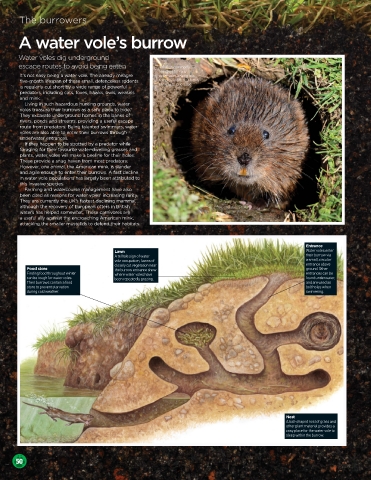
            A water vole’s burrow


            Water voles dig underground
            escape routes to avoid being eaten               Although commonly
                                                             mistaken for rats,
            It’s not easy being a water vole. The already meagre   water voles belong to a
            five-month lifespan of these small, defenceless rodents   completely different family
            is regularly cut short by a wide range of powerful   of rodents, Cricetidae
            predators, including cats, foxes, hawks, owls, weasels
            and mink.
              Living in such hazardous hunting grounds, water
            voles treasure their burrows as a safe place to hide.
            They excavate underground homes in the banks of
            rivers, ponds and streams, providing a useful escape
            route from predators. Being talented swimmers, water
            voles are also able to enter their burrows through
            underwater entrances.
              If they happen to be spotted by a predator while
            foraging for their favourite water-dwelling grasses and
            plants, water voles will make a beeline for their holes.
            These provide a snug haven from most predators.
            However, one animal, the American mink, is slender
            and agile enough to enter their burrows. A fast decline
            in water vole populations has largely been attributed to
            this invasive species.
              Farming and watercourse management have also
            been cited as reasons for water voles’ increasing rarity.
            They are currently the UK’s fastest declining mammal,
            although the recovery of European otters in British
            waters has helped somewhat. These carnivores are
            a useful ally against the encroaching American mink,
            attacking the smaller mustelids to defend their habitats.


                                                                                                                 Entrance
                                              Lawn                                                               Water voles enter
                                              A telltale sign of water                                           their burrow via
                                              vole occupation, lawns of                                          a small, circular
                                              closely cut vegetation near                                        entrance above
               Food store                     the burrow entrance show                                           ground. Other
               Finding food throughout winter   where water voles have                                           entrances can be
               can be tough for water voles.   been repeatedly grazing.                                          found underwater,
               Their burrows contain a food                                                                      and are used as
               store to prevent starvation                                                                       bolt holes when
               during cold weather.                                                                              swimming.


                                                                                                          Nest
                                                                                                          A ball-shaped nest of grass and
                                                                                                          other plant material provides a
                                                                                                          cosy place for the water vole to
                                                                                                          sleep within the burrow.


           50


       044-052_The Burrowers.indd   50                                                                                       20/07/2016   14:51

