


Page 47 - World of Animals - Issue #36
P. 47
The burrowers

              A fox’s den                                                                                 Entrance
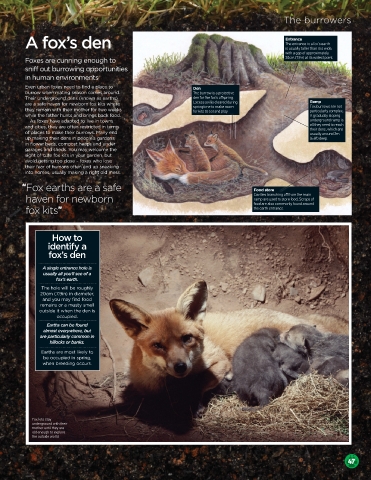
                                                                                                          The entrance to a fox’s earth
                                                                                                          is usually taller than it is wide,
                                                                                                          with a gap of approximately
                                                                                                          20cm (7.9in) at its widest point.
              Foxes are cunning enough to                                                                 20cm (7.9in) at its widest point.
              sniff out burrowing opportunities
              in human environments


              Even urban foxes need to find a place to                    Den
              burrow when mating season comes around.                    The burrow is a protective
              Their underground dens (known as earths)                   den for the fox’s offspring.

              are a safe haven for newborn fox kits where                Excess soil is cleared during            Ramp
                                                                                                                  Fox burrows are not
                                                                         springtime to make room
              they remain with their mother for two weeks                for kits to eat and play.                particularly complex.
              while the father hunts and brings back food.                                                        A gradually sloping
                As foxes have adapted to live in towns                                                            underground ramp is
              and cities, they are often restricted in terms                                                      all they need to reach
                                                                                                                  their dens, which are
              of places to make their burrows. Many end                                                           usually around 2m
              up making their dens in people’s gardens;                                                           (6.6 ) deep.

              in flower beds, compost heaps and under

              garages and sheds. You may welcome the
              sight of cute fox kits in your garden, but
              avoid getting too close – foxes who lose
              their fear of humans often end up sneaking
              into homes, usually making a right old mess.
             “Fox earths are a safe                                                           Food store

              haven for newborn                                                               Cavities branching off from the main
                                                                                              ramp are used to store food. Scraps of
                                                                                              food are also commonly found around
              fox kits”                                                                       the earth entrance.


                       How to
                      identify a
                      fox’s den


                    A single entrance hole is
                    usually all you’ll see of a
                         fox’s earth.
                    The hole will be roughly
                   20cm (7.9in) in diameter,
                    and you may find food

                   remains or a musty smell
                   outside it when the den is
                         occupied.
                      Earths can be found
                    almost everywhere, but
                   are particularly common in
                       hillocks or banks.
                    Earths are most likely to
                    be occupied in spring,
                    when breeding occurs.


                 Fox kits stay
                 underground with their
                 mother until they are
                 old enough to explore
                 the outside world


                                                                                                                               47


       044-052_The Burrowers.indd   47                                                                                       20/07/2016   14:51

