


Page 55 - World of Animals - Issue #36
P. 55
Wild Costa Rica


                                         Travel expert
                                         Sarah Meils’ natural curiosity about the world inspired her to pursue a degree in   Map key
                                         tourism and she is now a travel writer for Costa Rica Experts
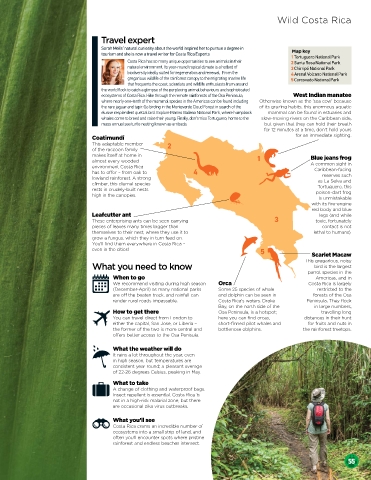
                                                                                                           1 Tortuguero National Park
                                                  Costa Rica has so many unique opportunities to see animals in their   2 Santa Rosa National Park
                                                  natural environment. Its year-round tropical climate is a hotbed of   3 Chirripó National Park
                                                  biodiversity ideally suited for regeneration and renewal.  From the   4 Arenal Volcano National Park
                                                  gregarious wildlife of the rainforest canopy to the migrating marine life   5 Corcovado National Park
                                                  that frequents the coast, scientists and wildlife enthusiasts from around
                                         the world flock to catch a glimpse of the perplexing animal behaviours and sophisticated

                                         ecosystems of Costa Rica. Hike through the remote rainforests of the Osa Peninsula,   West Indian manatee
                                         where nearly one-tenth of the mammal species in the Americas can be found including   Otherwise known as the 'sea cow' because
                                         the rare jaguar and tapir. Go birding in the Monteverde Cloud Forest in search of the   of its grazing habits, this enormous aquatic
                                         elusive resplendent quetzal bird. Explore Marino Ballena National Park, where humpback   mammal can be found in estuaries and
                                         whales come to breed and raise their young. Finally, don’t miss Tortuguero, home to the   slow-moving rivers on the Caribbean side,
                                         mass annual sea turtle nesting known as arribada.        but given that they can hold their breath
                                                                                                  for 12 minutes at a time, don't hold yours
                                      Coatimundi                                                             for an immediate sighting.
                                      This adaptable member
                                      of the raccoon family
                                      makes itself at home in                                                     Blue jeans frog
                                      almost every wooded                                                         A common sight in
                                      environment Costa Rica                                                        Caribbean-facing
                                      has to offer – from oak to                                                      reserves such
                                      lowland rainforest. A strong                                                   as La Selva and
                                      climber, this diurnal species                                                  Tortuguero, this
                                      rests in crudely-built nests                                                  poison-dart frog
                                      high in the canopies.
                                                                                                                     is unmistakable

                                                                                                                   with its fire-engine
                                                                                                                   red body and blue
                                      Leafcutter ant                                                                 legs (and while
                                      These enterprising ants can be seen carrying                                  toxic, fortunately
                                      pieces of leaves many times bigger than                                         contact is not
                                      themselves to their nest, where they use it to                               lethal to humans).
                                      grow a fungus, which they in turn feed on.

                                      You'll find them everywhere in Costa Rica –
                                      even in the cities!
                                                                                                                   Scarlet Macaw
                                                                                                                This gregarious, noisy
                                      What you need to know                                                         bird is the largest
                                                                                                                 parrot species in the
                                             When to go                                                             Americas, and in
                                             We recommend visiting during high season   Orca                      Costa Rica is largely
                                             (December-April) as many national parks   Some 25 species of whale      restricted to the
                                             are off the beaten track, and rainfall can   and dolphin can be seen in   forests of the Osa
                                             render rural roads impassable.       Costa Rica's waters. Drake     Peninsula. They flock

                                                                                  Bay, on the north side of the     in large numbers,
                                             How to get there                     Osa Peninsula, is a hotspot;        travelling long
                                             You can travel direct from London to   here you can find orcas,     distances in their hunt


                                             either the capital, San Jose, or Liberia –   short-finned pilot whales and   for fruits and nuts in
                                             the former of the two is more central and   bottlenose dolphins.   the rainforest treetops.
                                             offers better access to the Osa Penisula.
                                             What the weather will do
                                             It rains a lot throughout the year, even
                                             in high season, but temperatures are
                                             consistent year round; a pleasant average
                                             of 22-26 degrees Celsius, peaking in May.
                                             What to take
                                             A change of clothing and waterproof bags.
                                             Insect repellent is essential. Costa Rica is
                                             not in a high-risk malarial zone, but there
                                             are occasional zika virus outbreaks.

                                             What you’ll see
                                             Costa Rica crams an incredible number of
                                             ecosystems into a small strip of land, and
                                             often you’ll encounter spots where pristine
                                             rainforest and endless beaches intersect.

                                                                                                                               55


       054-061_Explore the Earth.indd   55                                                                                   20/07/2016   16:32

