


Page 59 - World of Animals - Issue #36
P. 59
Sniff around for tapirs                                                             Know your toucan


              The Baird’s tapir is the size and shape of a pig and has the
              prehensile trunk of an elephant, but it’s actually more closely
              related to horses and rhinos. It’s Costa Rica’s biggest land
              mammal, and its range is restricted to protected forest land such
              as Corcovado, Monteverde and Santa Rosa National Park. It is
              most active at dawn and dusk, when it goes foraging for fruits on

              the forest floor. Although the tapir moves with a silent grace that

              belies its stocky appearance, tour guides find it easy to track down
              because they rarely roam far from water sources.                                    Keel-billed toucan
                                                                                                  The most recognisable of all Costa Rica’s toucan
                                                                                                  species, the highly sociable, keel-billed toucan travels

                                                                                                  around the rainforest in small flocks of a dozen or so
                                                                                                  individuals and can be seen at dawn or dusk.


                                                                                                  Chestnut-mandibled toucan
                                                                                                  Costa Rica’s largest toucan inhabits lowland forest
                                                                                                  habitats. While the chestnut-mandibled toucan mostly
                                                                                                  dines on fruit, its versatile beak also enables it to make
                                                                                                  meals of lizards and insects.


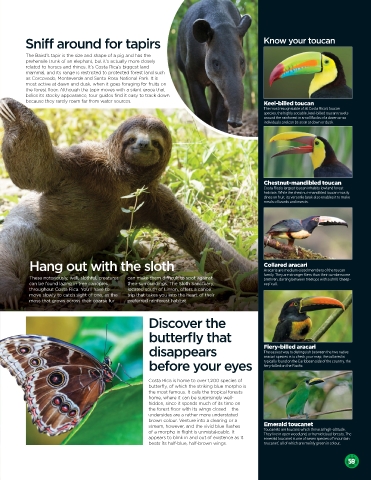
                Hang out with the sloth                                                           Collared aracari
                                                                                                  Aracaris are medium-sized members of the toucan
                                                                                                  family. They are stronger fliers than their cumbersome


               These notoriously, well, slothful, creatures   can make them difficult to spot against   brethren, darting between treetops with a shrill ‘cheep-
               can be found lazing in tree canopies   their surroundings. The Sloth Sanctuary,    eep’ call.
               throughout Costa Rica. You’ll have to   located south of Limon, offers a canoe
               move slowly to catch sight of one, as the   trip that takes you into the heart of their
               moss that grows across their coarse fur   preferred rainforest habitat.
                                                         Discover the


                                                          butterfly that

                                                         disappears                               Fiery-billed aracari
                                                                                                  The easiest way to distinguish between the two native
                                                                                                  aracari species is to check your map; the collared is
                                                          before your eyes                        typically found on the Caribbean side of the country, the


                                                                                                  fiery-billed on the Pacific.
                                                         Costa Rica is home to over 1,200 species of
                                                         butterfly, of which the striking blue morpho is

                                                         the most famous. It calls the tropical forests
                                                         home, where it can be surprisingly well-
                                                         hidden, since it spends much of its time on

                                                         the forest floor with its wings closed – the
                                                         undersides are a rather more understated
                                                         brown colour. Venture into a clearing or a

                                                         stream, however, and the vivid blue flashes   Emerald toucanet
                                                         of a morpho in flight is unmistakeable. It   Toucanets are toucans which thrive at high-altitude.

                                                                                                  They live in open woodland, or humid cloud forests. The
                                                         appears to blink in and out of existence as it   emerald toucanet is one of seven species of ‘mountain
                                                         beats its half-blue, half-brown wings.   toucanet’, all of which are mainly green in colour.
                                                                                                                               59


       054-061_Explore the Earth.indd   59                                                                                   20/07/2016   15:31

