


Page 64 - World of Animals - Issue #36
P. 64
Conserving sharks


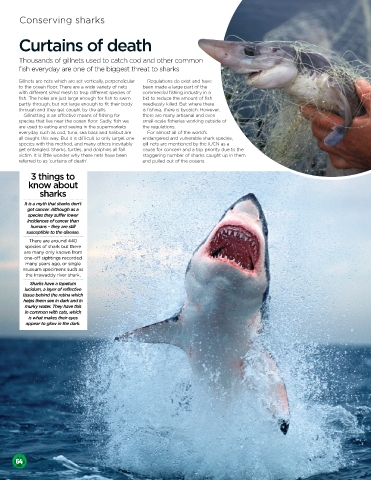
            Curtains of death


            Thousands of gillnets used to catch cod and other common
            fish everyday are one of the biggest threat to sharks
            Gillnets are nets which are set vertically, perpendicular   Regulations do exist and have
            to the ocean floor. There are a wide variety of nets   been made a large part of the
            with different sized mesh to trap different species of   commercial fishing industry in a
            fish. The holes are just large enough for fish to swim   bid to reduce the amount of fish
            partly through, but not large enough to fit their body   needlessly killed. But where there
            through and they get caught by the gills.   is fishing, there is bycatch. However,
              Gillnetting is an effective means of fishing for   there are many artisanal and even
            species that live near the ocean floor. Sadly, fish we   small-scale fisheries working outside of
            are used to eating and seeing in the supermarkets   the regulations.
            everyday such as cod, tuna, sea bass and halibut are   For almost all of the world’s
            all caught this way. But it is difficult to only target one   endangered and vulnerable shark species,
            species with this method, and many others inevitably   gill nets are mentioned by the IUCN as a
            get entangled. Sharks, turtles, and dolphins all fall   cause for concern and a top priority due to the
            victim. It is little wonder why these nets have been   staggering number of sharks caught up in them
            referred to as ‘curtains of death’.        and pulled out of the oceans.

                3 things to
               know about
                   sharks
              It is a myth that sharks don’t
               get cancer. Although as a
               species they suffer lower
               incidences of cancer than
                humans – they are still
               susceptible to the disease.
               There are around 440
              species of shark but there
              are many only known from
              one-off sightings recorded
              many years ago, or single
             museum specimens such as
              the Irrawaddy river shark.
                Sharks have a tapetum
              lucidum, a layer of reflective
             tissue behind the retina which
             helps them see in dark and in
              murky water. They have this
              in common with cats, which
               is what makes their eyes
              appear to glow in the dark.


           64


       062-066_ConservingSharks_NH.indd   64                                                                                 20/07/2016   15:33

