


Page 66 - World of Animals - Issue #36
P. 66
Conserving sharks


                        Saving sharks
                        Paul Cox is the Managing Director of The Shark Trust
                       What state are shark populations in currently?
                       Scientists estimate that approximately one quarter of shark
                       and ray species are threatened with extinction and require
                       immediate conservation action. This includes some of the
            better-known species like the great white, great hammerhead and whale shark
            but also includes many less charismatic but nevertheless valuable species.
              This estimate is based on the IUCN Red List, which in 2013 found that 181
            out of the 1038 species of sharks and rays assessed fell into one of the three

            “threatened” categories, including 20 species classified as Critically Endangered.
            Almost half (472 species), however, are classed as Data Deficient, meaning that

            we just don’t know enough about the populations to assess their status.
            Can you tell us more about the work and projects you are involved in?

            We are involved in various wildlife protection, fisheries policy, and responsible
            trade projects, working with partners around the world to advocate for changes

            that will safeguard sharks.  Our fisheries action is currently spearheaded by our
            ‘No Limits?’ campaign, which is targeting an end to uncontrolled shark fishing for

            ‘No Limits?’ species, including the blue and shortfin mako sharks.

              Another of our biggest projects, the Great Eggcase Hunt, encourages everyone
            to explore their local beaches, to search for and submit records of the eggcases
            from local sharks and rays, building a valuable knowledge base.
            What successes have there been so far?
            There have been many, from the landmark protection of the basking shark in
            the UK in the late 1990s to an International Plan of Action for sharks in 1999.  In
            2013, seven commercially exploited species of sharks and ray were CITES listed,
            restricting trade across the world, and in the same year the EU Finning Regulation
            set the international standard for a move away from the practice of finning at sea.

            But there is still much to be done: We need more science to assess species and
            develop conservation plans; we need more policy change to set the agenda; we


            need a shi¡ to sustainable shark fisheries coupled with a responsible global trade
            in shark products.
            Sadly, sharks are notoriously unpopular – how can we change people’s minds?
            I don’t think people need to like sharks to appreciate the importance of not
            driving their populations to extinction. We just need, as a society, to make better
            decisions to safeguard the future of our wildlife, and those that do value wildlife to
            be vocal and active.

            What are the main threats facing sharks and how can we overcome them?
            The biggest current threat to sharks is overfishing. Not shark fishing per se but


            uncontrolled and unmanaged shark fishing. We have to get a control on shark


            fishing, push for science-based management, for sustainable fisheries and, take
            steps to reduce the trade in unsustainable products.
              Shark conservation is a global issue which requires collaboration. The Shark
            Trust published a comprehensive 10-year plan as part of a global partnership with
            WWF, IUCN Shark Specialist Group, Shark Advocates International, TRAFFIC and
            WCS. There is hope if we act quickly and decisively to protect threatened species,

            manage fisheries, reform trade and tackle demand for shark products.
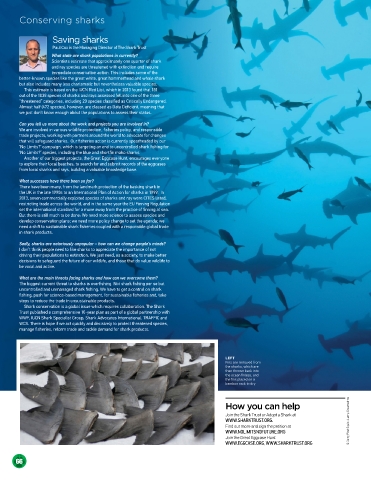
                                                                                    LEFT
                                                                                    Fins are removed from
                                                                                    the sharks, which are
                                                                                    then thrown back into
                                                                                    the ocean fi nless, and
                                                                                    the fi ns placed on a
                                                                                    bamboo rack to dry


                                                                                    How you can help

                                                                                    Join the Shark Trust or Adopt a Shark at
                                                                                    WWW.SHARKTRUST.ORG.                         © Getty; Pixel Squid; Alamy; Dreamstime
                                                                                    Find out more and sign the petition at
                                                                                    WWW.NOLIMITSNOFUTURE.ORG
                                                                                    Join the Great Eggcase Hunt
                                                                                    WWW.EGGCASE.ORG, WWW.SHARKTRUST.ORG

           66


       062-066_ConservingSharks_NH.indd   66                                                                                 20/07/2016   15:33

