


Page 69 - World of Animals - Issue #36
P. 69
help. That’s why we want to get something going   work out how we can practically help. Then we   Diary of
              there.                                   build from there.
                I’m also off to Thailand on Monday. We set up
              international training centres in Thailand and India,   Are there any projects that really stand out   a global vet
              where we train vets on the front line of animal   for you?

              welfare in humane techniques. So they can safely   When I first set the website up, I was working
              and kindly help animals in the areas where they   from my garage as an evening project. A request   Tackling rabies
              live. We train around 400 vets a year in Thailand   came through from a charity in India, where some   on the front line
              and India to use antibiotics and do surgery – it’s   American tourists had witnessed piles of dead
              going really well!                       dogs on the side of the road. The wife of the   We work very synergistically with our sister
                We are helping donkeys that are so desperately   doctor who owned the local hospital had been
              valued in India to cart materials that their owners   attacked by wild dogs, so the reaction from the   charity Mission Rabies, going to global
                                                                                                rabies hotspots. It is a horrible disease.
              (often just through lack of education) will slice   local municipality was to kill all the dogs – they   It kills a child every nine minutes around

              open the sides of their noses to get better airflow,   were paying per tail. The American tourists found   the world and it’s completely preventable
              among other things… We go there, we treat those   a local charity, and I received an email. I went over   by vaccinating dogs, as 99 per cent of
              donkeys, we educate the owners and we train up   there and straight away I had to see a cow that   all rabies cases are transmitted through
              the local para-vets who can give the animals on-  was heavily pregnant and had broken both its   dog bites in Africa and Asia. We do very
              going support. So the donkeys have a better life   legs. Of course, cows are sacred, so I bought the   focused campaigns; in May for example we
              and they’re also more productive.        cow from the family and I shot it but cut the baby   went to Blantyre in Malawi, which has the
                Among other things, we are also trying to   calf out, which survived. I gave the calf back to
              rescue lions in Armenia that inhabit the ‘World’s   the family. Then we went to the place where they   highest rate of child rabies deaths of any
                                                                                                city in the whole of Africa. We vaccinated
              saddest zoo’, living in tiny little box-like cages for   were killing the dogs and we neutered 70 dogs   35,600 dogs in 20 days.
              four years. We have got them out of those cages   in two days. Local TV crews saw what we were   When we are there, our days usually
              now but we need to work on getting them back   doing and there was huge community support.   start at about 4-5am. Normally if we are
              to the UK to a lion sanctuary here. There’s a lot   They stopped killing the dogs and instead started   doing a rabies drive we will go out for a
              going on!                                a sterilisation campaign.                morning capture because that’s when you’ll
                                                        Thanks to the work of all the people there,
              How do you identify the areas where your help   the entire area has now been declared rabies-  get the dogs, at dusk and dawn. I’ll spend
                                                                                                a few hours out and about, catching and
              is needed?                               free. I went back and saw the family with the   vaccinating dogs and going door to door,
              Often requests come in. We work with charities   calf, and they’re now really happy. Another of   marking, GPS logging and data recording.
              in much smaller places that really need our help.   my favourites was when we went to the refugee   Then it’s back for breakfast! And then
              We never send money, we always send ourselves   camp in Kenya. It just goes to show that people   the rest of the day is quite varied – it might
              instead, so we go over and meet with them and   living in really tough places do love their animals!
                                                                                                include operations and treatments, dealing
                                                                                                with any scenarios and talking to different
              “It just goes to show that people living in really                                people, or getting the community support
                                                                                                and going into schools to give talks about
                        tough places do love their animals!”                                    what we are about and what we’re doing.
                                                                                                Then at about 3-4pm we will go out
                                                                                                again until about 6-7.30pm, catching and
                                                                                                vaccinating more dogs. When we catch
                                                                                                them, we give them a jab and then send
                                                                                                them right on their way. Then it’s home for
                                                                                                a nice cold beer!
                                                                                                  The main issue is sustainability. Anyone
                                                                                                can go in and vaccinate dogs, but the
                                                                                                thing that will make the difference is
                                                                                                training the locals up. We’ve set up this
                                                                                                whole education component for that;
                                                                                                during the 20 days that we were in Malawi
                                                                                                we educated 91,000 children!
                                                                                                How can people get
                                                                                                involved and help out?
                                                                                                First things first: check out the website!

                                                                                                There’s a lot of information there on how
                                                                                                you can get involved. You can become
                                                                                                a supporter of WVS, which is massive.
                                                                                                With people’s support and donations we
                                                                                                can help with so many amazing projects!
                                                                                                And if anyone wants to be a vet, you just
                                                                                                have to stick at it – I have no regrets. It’s a
                                                                                                wonderful job. We also run volunteer trips
                                                                                                for ready-trained vets that cater for all
                                                                                                different types of people.

                                                                                                For more information, check out
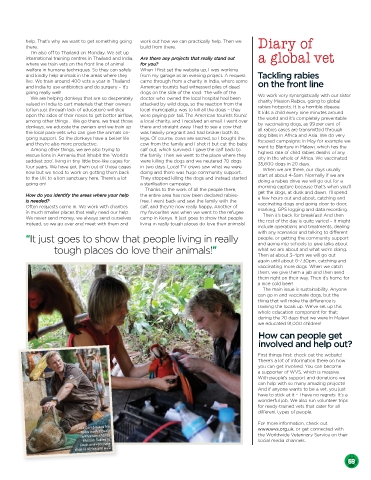
                                Luke Gamble and his                                             www.wvs.org.uk, or get connected with
                                  team work closely
                                  with sister charity                                           the Worldwide Veterinary Service on their
                                  Mission Rabies to                                             social media channels.
                                 catch and vaccinate
                                dogs in Africa and Asia
                                                                                                                               69


       068-069_WOA_036_Working4Wildlife.indd   69                                                                            20/07/2016   15:49

