


Page 88 - Patchwork & Quilting - UK (February 2020)
P. 88
TECHNIQUE // in a nutshell

                                 IN A NUTSHELL


                  PREPARATION OF FABRICSŏ            PRESSINGŏ
                  It is advisable to use 100% cotton fabric if the   When piecing fabrics it is essential to press   Always cut away from the body and store
                  finished item is to be laundered. Ideally fabrics  each seam as it is stitched. Firstly, press the   cutter out of the reach of children. Cutting
                  should be washed and pressed before using   seam flat on the wrong side before opening   rulers come in a variety of sizes and are
                  as this allows for shrinkage and   the pieces, to set the stitches. Then, on right   usually marked in inches with  1 ⁄ 8" increments.
                  colourfastness. To check a fabric is colourfast,   side of the fabric, press both seams towards   To straighten the edge of the fabric prior to
                  dampen and lay it on top of a white cotton   the darker fabric using tip of the iron and   cutting strips, fold in half with selvedges
                  fabric and press. Check for any dye   then press again on the wrong side. Seams   together and place on cutting mat. Place
                  transferred to the white fabric.bIf the colour   can also be pressed open as this helps to   ruler on the fabric, at right angles to the fold
                  bleeds when the fabric is washed, rinse   distribute the bulk of fabric created when   and cut the fabric to give a straight edge.
                  repeatedly until water runs clear and, if   lots of seams meet at one point. Press rather   Place the cut edge of fabric to the left of the
                  necessary, soak in a solution of 3 parts water   than iron, preferably without steam. Spray   cutting board, if right handed (to the right, if
                  to 1 part vinegar.                 starch can also be used.b          left handed) then using the ruler, measure
                                                                                        width of strip to be cut. Hold ruler in place
                  TEMPLATE MAKINGŏ                   ROTARY CUTTINGŏ                    and cut along edge of the ruler. Several
                  These need to be accurately made from either  Squares, rectangles and other shapes can be   layers of fabric can be cut at one time.bStrips
                  rigid plastic or cardboard. The templates given  quickly cut from strips of fabric using a rotary   can then be sub cut into squares, rectangles,
                  on thebPattern Sheetbare usually full sized. A   cutter, a self-healing cutting mat and a   triangles and other shapes.
                  seam allowance of ¼" is used in all projects   special cutting ruler. A rotary cutter has a
                  unless otherwise stated. Refer to the Pattern   very sharp round blade which must be
                  Sheet for more information.        shielded at all times when not in use.

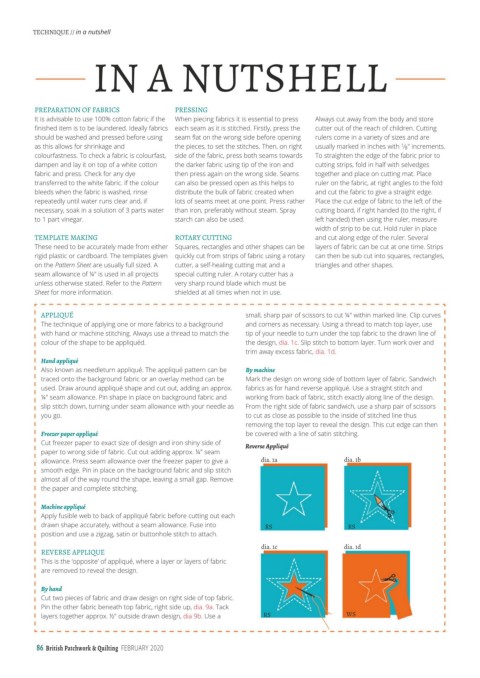
                    APPLIQUÉŏ                                          small, sharp pair of scissors to cut ¼" within marked line. Clip curves
                    The technique of applying one or more fabrics to a background   and corners as necessary. Using a thread to match top layer, use
                    with hand or machine stitching. Always use a thread to match the   tip of your needle to turn under the top fabric to the drawn line of
                    colour of the shape to be appliquéd.b              the design,bdia. 1c. Slip stitch to bottom layer. Turn work over and
                                                                       trim away excess fabric,bdia. 1d.b
                    Hand appliquéĿ
                    Also known as needleturn appliqué.bThe appliqué pattern can be   By machine
                    traced onto the background fabric or an overlay method can be   Mark the design on wrong side of bottom layer of fabric. Sandwich
                    used. Draw around appliqué shape and cut out, adding an approx.   fabrics as for hand reverse appliqué. Use a straight stitch and
                    ¼" seam allowance. Pin shape in place on background fabric and   working from back of fabric, stitch exactly along line of the design.
                    slip stitch down, turning under seam allowance with your needle as   From the right side of fabric sandwich, use a sharp pair of scissors
                    you go.                                            to cut as close as possible to the inside of stitched line thus
                                                                       removing the top layer to reveal the design. This cut edge can then
                    Freezer paper appliquéĿ                            be covered with a line of satin stitching.
                    Cut freezer paper to exact size of design and iron shiny side of   Reverse Appliqué
                    paper to wrong side of fabric. Cut out addingbapprox. ¼" seam
                    allowance. Press seam allowance over the freezer paper to give a   dia. 1a  dia. 1b
                    smooth edge. Pin in place on the background fabric and slip stitch
                    almost all of the way round the shape, leaving a small gap. Remove
                    the paper and complete stitching.b
                    Machine appliquéĿ
                    Apply fusible web to back of appliqué fabric before cutting out each
                    drawn shape accurately, without a seam allowance. Fuse into   RS            RS
                    position and use a zigzag, satin or buttonhole stitch to attach.b
                                                                           dia. 1c             dia. 1d
                    REVERSE APPLIQUEŏ
                    This is the ‘opposite’ of appliqué, where a layer or layers of fabric
                    are removed to reveal the design.b

                    By hand
                    Cut two pieces of fabric and draw design on right side of top fabric.
                    Pin the other fabric beneath top fabric, right side up,bdia. 9a. Tack
                    layers together approx. ½" outside drawn design,bdia 9b. Use a   RS         WS


                   86  British Patchwork & Quilting  FEBRUARY 2020

