


Page 91 - Patchwork & Quilting - UK (February 2020)
P. 91
TECHNIQUE // in a nutshell


                    Mitred Border
                                                                               BINDINGŏ
                                                                               Trim edges of the quilt so that all of the layers are even
                                                                               and the corners are square. For double fold binding,
                                                                               cut strips of fabric 2½" wide and long enough to go all
                                                                               the way round the edge of your quilt. Join strips as
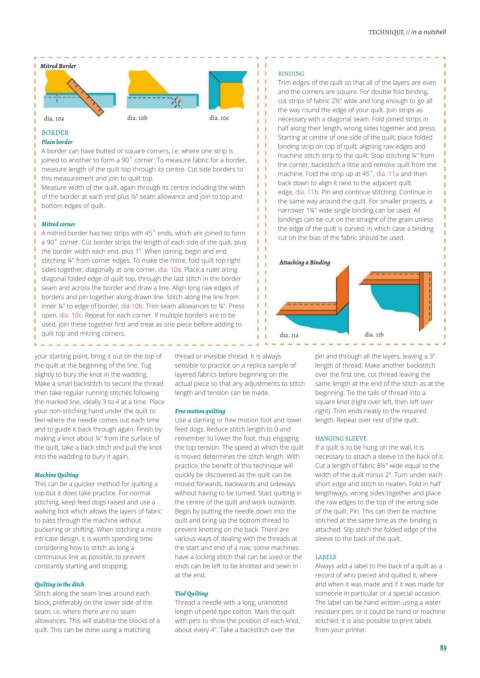
                     dia. 10a            dia. 10b             dia. 10c         necessary with a diagonal seam. Fold joined strips in
                                                                               half along their length, wrong sides together and press.
                    BORDERŏ                                                    Starting at centre of one side of the quilt, place folded
                    Plain border                                               binding strip on top of quilt, aligning raw edges and
                    A border can have butted or square corners, i.e.bwhere one strip is   machine stitch strip to the quilt. Stop stitching ¼" from
                    joined to another to form a 90˚ corner. To measure fabric for a border,
                    measure length of the quilt top through its centre. Cut side borders to   the corner, backstitch a little and remove quilt from the
                                                                               machine. Fold the strip up at 45˚,bdia. 11aband then
                    this measurement and join to quilt top.                    back down to align it next to the adjacent quilt
                    Measure width of the quilt, again through its centre including the width
                    of the border at each end plus ½" seam allowance and join to top and   edge,bdia. 11b. Pin and continue stitching. Continue in
                                                                               the same way around the quilt. For smaller projects, a
                    bottom edges of quilt.
                                                                               narrower 1¼" wide single binding can be used. All
                                                                               bindings can be cut on the straight of the grain unless
                    Mitred corner                                              the edge of the quilt is curved, in which case a binding
                    A mitred border has two strips with 45˚ ends, which are joined to form   cut on the bias of the fabric should be used.b
                    a 90˚bcorner. Cut border strips the length of each side of the quilt, plus
                    the border width each end, plus 1". When joining, begin and end
                    stitching ¼" from corner edges. To make the mitre, fold quilt top right   Attaching a Binding
                    sidesbtogether, diagonally at one corner, dia. 10a. Place a ruler along
                    diagonal folded edge of quilt top, through the last stitch in the border
                    seam and across the border and draw a line. Align long raw edges of
                    borders and pin together along drawn line. Stitch along the line from
                    inner ¼" to edge of border,bdia 10b. Trim seam allowances to ¼". Press
                    open, dia. 10c. Repeat for each corner. If multiple borders are to be
                    used, join these together first and treat as one piece before adding to
                    quilt top and mitring corners.                             dia. 11a             dia. 11b


                  your starting point, bring it out on the top of   thread or invisible thread. It is always   pin and through all the layers, leaving a 3"
                  the quilt at the beginning of the line. Tug   sensible to practice on a replica sample of   length of thread. Make another backstitch
                  slightly to bury the knot in the wadding.   layered fabrics before beginning on the   over the first one, cut thread leaving the
                  Make a small backstitch to secure the thread   actual piece so that any adjustments to stitch   same length at the end of the stitch as at the
                  then take regular running stitches following   length and tension can be made.   beginning. Tie the tails of thread into a
                  the marked line, ideally 3 to 4 at a time. Place                      square knot (right over left, then left over
                  your non-stitching hand under the quilt to   Free motion quilting     right). Trim ends neatly to the required
                  feel where the needle comes out each time   Use a darning or free motion foot and lower   length. Repeat over rest of the quilt.b
                  and to guide it back through again. Finish by   feed dogs. Reduce stitch length to 0 and
                  making a knot about ¼" from the surface of   remember to lower the foot, thus engaging   HANGING SLEEVEŏ
                  the quilt, take a back stitch and pull the knot   the top tension. The speed at which the quilt   If a quilt is to be hung on the wall, it is
                  into the wadding to bury it again.  is moved determines the stitch length. With   necessary to attach a sleeve to the back of it.
                                                     practice, the benefit of this technique will   Cut a length of fabric 8½" wide equal to the
                  Machine QuiltingĿ                  quickly be discovered as the quilt can be   width of the quilt minus 2". Turn under each
                  This can be a quicker method for quilting a   moved forwards, backwards and sideways   short edge and stitch to neaten. Fold in half
                  top but it does take practice.bFor normal   without having to be turned. Start quilting in   lengthways, wrong sides together and place
                  stitching, keep feed dogs raised and use a   the centre of the quilt and work outwards.   the raw edges to the top of the wrong side
                  walking foot which allows the layers of fabric   Begin by putting the needle down into the   of the quilt. Pin. This can then be machine
                  to pass through the machine without   quilt and bring up the bottom thread to   stitched at the same time as the binding is
                  puckering or shifting.bWhen stitching a more   prevent knotting on the back. There are   attached. Slip stitch the folded edge of the
                  intricate design, it is worth spending time   various ways of dealing with the threads at   sleeve to the back of the quilt.b
                  considering how to stitch as long a   the start and end of a row; some machines
                  continuous line as possible, to prevent   have a locking stitch that can be used or the   LABELSŏ
                  constantly starting and stopping.b  ends can be left to be knotted and sewn in   Always add a label to the back of a quilt as a
                                                     at the end.                        record of who pieced and quilted it, where
                  Quilting in the ditchĿ                                                and when it was made and if it was made for
                  Stitch along the seam lines around each   Tied QuiltingĿ              someone in particular or a special occasion.
                  block, preferably on the lower side of the   Thread a needle with a long, unknotted   The label can be hand written using a water
                  seam, i.e. where there are no seam   length of perlé type cotton. Mark the quilt   resistant pen, or it could be hand or machine
                  allowances. This will stabilise the blocks of a   with pins to show the position of each knot,   stitched. It is also possible to print labels
                  quilt. This can be done using a matching   about every 4". Take a backstitch over the   from your printer.
                                                                                                                        89

