


Page 90 - Patchwork & Quilting - UK (February 2020)
P. 90
TECHNIQUE // in a nutshell


                   ENGLISH PAPER PIECINGŏ                               Foundation piecing
                   A traditional patchwork method where the fabric is folded and stitched   dia. 9a              dia. 9b
                   over accurately cut stiff paper shapes. The fabric is cut out with an   6  3  4
                   added seam allowanceband tacked, or glue basted with a glue pen,   1
                   over the paper. The fabric covered shapes are then placed right sides
                   together and overstitched with small neat stitches. On completion all   5  2  7
                   of thebtacking stitches and papers are removed. Hexagons and           WS     RS
                   diamonds are often stitched in this way.b
                                                                         dia. 9c                                 dia. 9d
                   FOUNDATION PIECING ŏ
                   This is a very accurate piecing technique where fabric patches are
                   stitched tobthe reverse of a foundation block. It is particularly useful
                   where sharp points are needed. Depending on the material used, the
                   foundation fabric/paper can be either left permanently in place (e.g.   WS    RS
                   lightweight cotton fabric or sew-in interfacing) or can be removed (e.g.
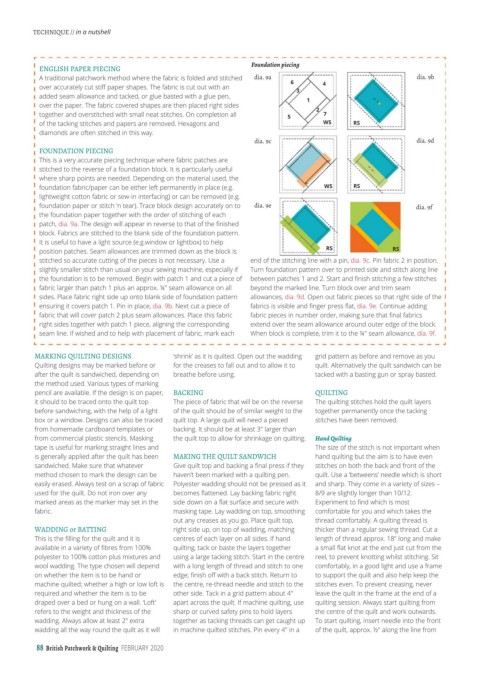
                   foundation paper or stitch ‘n tear).bTrace block design accurately on to   dia. 9e            dia. 9f
                   the foundation paper together with the order of stitching of each
                   patch,bdia. 9a. The design will appear in reverse to that of the finished
                   block. Fabrics are stitched to the blank side of the foundation pattern.
                   It is useful to have a light source (e.g.window or lightbox) to help
                   position patches. Seam allowances are trimmed down as the block is      RS              RS
                   stitched so accurate cutting of the pieces is not necessary. Use a   end of the stitching line with a pin,bdia. 9c. Pin fabric 2 in position.
                   slightly smaller stitch than usual on your sewing machine, especially if   Turn foundation pattern over to printed side and stitch along line
                   the foundation is to be removed. Begin with patch 1 and cut a piece of   between patches 1 and 2. Start and finish stitching a few stitches
                   fabric larger than patch 1 plus an approx. ¼" seam allowance on all   beyond the marked line. Turn block over and trim seam
                   sides. Place fabric right side up onto blank side of foundation pattern   allowances,bdia. 9d. Open out fabric pieces so that right side of the
                   ensuring it covers patch 1. Pin in place,bdia. 9b. Next cut a piece of   fabrics is visible and finger press flat,bdia. 9e. Continue adding
                   fabric that will cover patch 2 plus seam allowances. Place this fabric   fabric pieces in number order, making sure that final fabrics
                   right sides together with patch 1 piece, aligning the corresponding   extend over the seam allowance around outer edge of the block.
                   seam line. If wished and to help with placement of fabric, mark each   When block is complete, trim it to the ¼" seam allowance,bdia. 9f.b


                  MARKING QUILTING DESIGNS           ‘shrink’ as it is quilted. Open out the wadding   grid pattern as before and remove as you
                  Quilting designs may be marked before or   for the creases to fall out and to allow it to   quilt. Alternatively the quilt sandwich can be
                  after the quilt is sandwiched, depending on   breathe before using.b  tacked with a basting gun or spray basted.b
                  the method used. Various types of marking
                  pencil are available. If the design is on paper,   BACKINGŏ           QUILTINGŏ
                  it should to be traced onto the quilt top   The piece of fabric that will be on the reverse   The quilting stitches hold the quilt layers
                  before sandwiching, with the help of a light   of the quilt should be of similar weight to the   together permanently once the tacking
                  box or a window. Designs can also be traced   quilt top. A large quilt will need a pieced   stitches have been removed.
                  from homemade cardboard templates or   backing. It should be at least 3" larger than
                  from commercial plastic stencils. Masking   the quilt top to allow for shrinkage on quilting.b  Hand QuiltingĿ
                  tape is useful for marking straight lines and                         The size of the stitch is not important when
                  is generally applied after the quilt has been   MAKING THE QUILT SANDWICHŏ  hand quilting but the aim is to have even
                  sandwiched. Make sure that whatever   Give quilt top and backing a final press if they   stitches on both the back and front of the
                  method chosen to mark the design can be   haven’t been marked with a quilting pen.   quilt. Use a ‘betweens’ needle which is short
                  easily erased. Always test on a scrap of fabric   Polyester wadding should not be pressed as it   and sharp. They come in a variety of sizes –
                  used for the quilt. Do not iron over any   becomes flattened. Lay backing fabric right   8/9 are slightly longer than 10/12.
                  marked areas as the marker may set in the   side down on a flat surface and secure with   Experiment to find which is most
                  fabric.b                           masking tape. Lay wadding on top, smoothing   comfortable for you and which takes the
                                                     out any creases as you go. Place quilt top,   thread comfortably. A quilting thread is
                  WADDING or BATTINGŏ                right side up, on top of wadding, matching   thicker than a regular sewing thread. Cut a
                  This is the filling for the quilt and it is   centres of each layer on all sides.bIf hand   length of thread approx. 18" long and make
                  available in a variety of fibres from 100%   quilting, tack or baste the layers together   a small flat knot at the end just cut from the
                  polyester to 100% cotton plus mixtures and   using a large tacking stitch. Start in the centre   reel, to prevent knotting whilst stitching. Sit
                  wool wadding. The type chosen will depend   with a long length of thread and stitch to one   comfortably, in a good light and use a frame
                  on whether the item is to be hand or   edge; finish off with a back stitch. Return to   to support the quilt and also help keep the
                  machine quilted; whether a high or low loft is   the centre, re-thread needle and stitch to the   stitches even. To prevent creasing, never
                  required and whether the item is to be   other side. Tack in a grid pattern about 4"   leave the quilt in the frame at the end of a
                  draped over a bed or hung on a wall. ‘Loft’   apart across the quilt. If machine quilting, use   quilting session. Always start quilting from
                  refers to the weight and thickness of the   sharp or curved safety pins to hold layers   the centre of the quilt and work outwards.
                  wadding. Always allow at least 2" extra   together as tacking threads can get caught up   To start quilting, insert needle into the front
                  wadding all the way round the quilt as it will   in machine quilted stitches. Pin every 4" in a   of the quilt, approx. ½" along the line from
                   88  British Patchwork & Quilting  FEBRUARY 2020

