


Page 157 - (DK Eyewitness) Travel Guide - Hungary
P. 157
NOR THERN TR ANSD ANUBIA 155
major attractions. While it is 6 Pápa
possible with the naked eye 51 km (32 miles) northwest of Vesz
to make out the shapes of prém. Road Map B3. * 34,000.
houses, the theatre and the £ from Budapest, Tatabánya, Győr.
forum, the guidebook available @ from Tatabánya, Veszprém. n
from the ticket office is a must Tourinform, Márton István utca 10, (89)
to understand how it all worked. 77 70 47. ∑ papa.hu
Digs continue: unearthed
treasure (including pottery, An important fortified town first
coins, masonry and weaponry) mentioned in 1051, Pápa was held
is displayed in a small museum by the Turks from 1594 to 1683. It
by the entrance. There are Greek fell into decline after being razed
and Roman plays and other by fire in 1685. In the 18th century
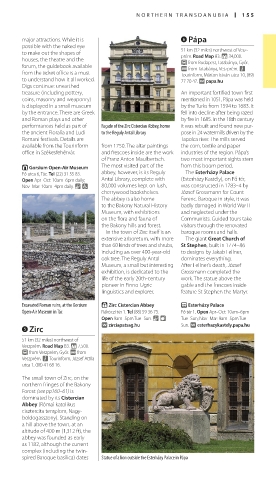
performances held as part of Façade of the Zirc Cistercian Abbey, home it was rebuilt and found new pur
the ancient Floralia and Ludi to the Reguly Antal Library pose in 24 watermills driven by the
Romani festivals. Details are Tapolca river. The mills served
available from the Tourinform from 1750. The altar paintings the corn, textile and paper
office in Székesfehérvár. and frescoes inside are the work industries of the region. Pápa’s
of Franz Anton Maul bertsch. two most important sights stem
T Gorsium Open-Air Museum The most visited part of the from this boom period.
Fő utca 6, Tác. Tel (22) 31 55 83. abbey, however, is its Reguly The Esterházy Palace
Open Apr–Oct: 10am–6pm daily; Antal Library, complete with (Esterházy Kastély), on Fő tér,
Nov–Mar: 10am–4pm daily. & 7 80,000 volumes kept on lush, was constructed in 1783–4 by
cherrywood bookshelves. József Grossmann for Count
The abbey is also home Ferenc. Baroque in style, it was
to the Bakony Natural History badly damaged in World War II
Museum, with exhibitions and neglected under the
on the flora and fauna of Communists. Guided tours take
the Bakony hills and forest. visitors through the renovated
In the town of Zirc itself is an baroque rooms and halls.
extensive arboretum, with more The giant Great Church of
than 60 kinds of trees and shrubs, St Stephen, built in 1774–86
including an over 400 yearold to designs by Jakab Fellner,
oak tree. The Reguly Antal dominates everything.
Museum, a small but interesting After Fellner’s death, József
exhibition, is dedicated to the Gross mann completed the
life of the early 20thcentury work. The statue above the
pioneer in FinnoUgric gable and the frescoes inside
linguistics and explorer. feature St Stephen the Martyr.
Excavated Roman ruins, at the Gorsium R Zirc Cistercian Abbey P Esterházy Palace
Open-Air Museum in Tác Rákóczi tér 1. Tel (88) 59 36 75. Fő tér 1. Open Apr–Oct: 10am–6pm
Open 9am–5pm Tue–Sun. & 8 Tue–Sun; Nov–Mar: 9am–5pm Tue–
∑ zirciapatsag.hu Sun. ∑ esterhazykastely.papa.hu
5 Zirc
51 km (32 miles) northwest of
Veszprém. Road Map B3. * 7,500.
£ from Veszprém, Győr. @ from
Veszprém. n Tourinform, József Attila
utca 1, (88) 41 68 16.
The small town of Zirc, on the
northern fringes of the Bakony
Forest (see pp160–61) is
dominated by its Cister cian
Abbey (Római katolikus
cisztercita templom, Nagy
boldo gasszony). Standing on
a hill above the town, at an
altitude of 400 m (1,312 ft), the
abbey was founded as early
as 1182, although the current
complex (including the twin
spired Baroque basilica) dates Statue of a lion outside the Esterházy Palace in Pápa
154-155_EW_Hungary.indd 155 18/09/17 3:40 pm

