


Page 160 - (DK Eyewitness) Travel Guide - Hungary
P. 160
158 HUNGAR Y REGION B Y REGION SZÉKESFEHÉR V ÁR 159
Exploring Székesfehérvár P Hiemer-House soldiers and castles and other area and of Székesfehérvár’s Serb
Hiemer-Ház toys, which have all been community, of its traders and
Around 897, the Magyar chieftain Árpád (see p39) created Oskola utca 2–4. Tel (22) 53 72 61. assembled by Éva Moskovszky, a crafts men, with exhibitions on
a permanent settlement, and with it the first Hungarian Open by arrangement only. 7 retired librarian of the Hungarian shoemakers, leather-workers and
town, on the Székesfehérvár plain. Prince Géza, his great- The Hiemer House, with its National Museum. The detail and furriers. Also on Rác utca is the
grandson, built a castle here in 972, and St István, Géza’s Baroque-Rococo main façade, opulence of these toys are aston- Ráctemplom, the single-nave Serb
son, erected a vast basilica. The walled city that grew up consists of three medieval ishing – the dolls wear genuine church, a Baroque 18th- century
around it was the site of Hun gary’s Diet, or Parliament, buildings on Hungary’s National pearl necklaces and the tiny building with colour ful, fully
homes, copies of homes built
restored icons. Many of them
Heritage list. One building,
for 500 years, until the Turks occupied the city and the adjoining Jókai Street, once between 1800 and 1930, are had been hidden by soot for the
inhabitants fled in 1543. Székesfehérvár flourished in functioned as a parsonage; immacu lately furnished with real best part of a century.
the 1800s and 1900s. In World War II much of the town was another, the Font house, was Herend porcelain (see p207). Even
destroyed, but the historic centre (see pp156–7) was spared. a school and store. The Caraffa the clocks on the doll’s house + Bory Castle
building was a combination walls are in full working order. Bory Vár
of school, flats and stores. One Máriavölgy út 54. Tel (22) 30 55 70.
E St István Király Museum E Deák Collection part of the complex houses the R Carmelite Church Open Mar–mid-Oct: 9am–5pm daily;
Szent István Király Múzeum Városi Képtár Deák-gyűjtemény Hetedhét Toy Museum (below). Karmelita templom late Oct–mid-Nov: 9am–4pm daily.
Fő utca 6. Tel (22) 31 55 83. Oskola utca 10. Tel (22) 32 94 31. Petőfi Sándor utca 2. Open Apr–mid- Detail on the clock at No. 9 Kossuth Street Closed late Nov–Feb. & ∑ bory-
Open 10am– 6pm daily. & 8 Open 10am–6pm Tue–Sun. & 7 Oct: 9am–6pm Tue–Sun. 7 var.hu
German and Hungarian only. An overview of the history of Not fully completed until 1769, clock is the focal point of a The most-visited sight in
∑ szikm.hu modern Hungarian art, Dénes the church was designed by colourful Secessionist house Székesfehérvár is the whim sical
The friary of the Cistercian Deák’s (1931–93) collection an anonymous architect. The that has become increasingly Bory Castle, built over two
church (see p157) houses a features early 20th-century Carmelites were so des perate hemmed in by the less inter- decades by the sculptor and
collection of artifacts from artists Rippl-Rónai and Gulácsy, for a place to worship that esting build ings sur rounding it. architect Jenő Bory (1879–1959).
the Fejér region. The earliest modern European School artists they began holding their The interior of the building can Construc tion first began in the
exhibits go back as far as the Imre Ámos and Margit Anna services in the unfinished (but be visited by prior arrangement. mid-1920s, when Bory had a
Neolithic Age, and there is and Tihamér Gyarmathy’s consecrated) church in 1732, a group of his students build him
also a signifi cant collection con temporary abstract art. year after construction began, E Open-Air Ethnographical a small cottage and plant a
of Roman treasure. The most Sculpture and graphic art are when the building was little Museum vineyard. He then added various
recent finds include parts of also represented. more than a shell. The exterior Palotavárosi Skanzen parts to it, the designs becoming
the sarcophagus of St István, is Baroque, with a single, Rác utca 11. Tel (22) 31 55 83. gradually more colourful and
most of which is in the Gar den R St István’s Cathedral modest tower. The real glory Open by arrangement. & 8 7 daring, until, at the time of his
of Ruins (see p157). The friary Szent István Székesegyház of the church, however, are Unlike other village museums in death, the cottage had grown
itself was built at the same time Arany János utca 9. Tel (22) 31 the colourful, dramatic ceiling Hungary, which are usually located into a veritable fantasy land,
as the church, and completed 51 14. Open Apr–mid-Oct: 9am– Exhibits from the Hetedhét Toy Museum, frescoes inside, most of which outside towns, Palotavárosi is set part Roman forum, part Gothic
in 1751. It first housed Jesuit, 5pm Tue–Sun. displaying fascinating detail are the work of Franz Anton close to the city centre, in the castle, with touches of just
then Franciscan, and finally Béla IV founded this church, Maulbertsch, a native of Vienna suburbs of Székesfehérvár. Visitors about every other archi tectural
Cistercian monks. The museum later renovated in Baroque style, E Hetedhét Toy Museum who worked on a number of entering the cobbled streets of style thrown in. Some of the
has temporary exhibitions at in which parts of the original Hetedhét Játékmúzeum churches in the area around the museum (which for centuries castle’s rooms exhibit Bory’s
the Cere monial Hall, Hungarian coronation ceremony Oskola utca 2-4. Tel (22) 20 26 01. Lake Balaton. He also painted was the Rácváros, or Serb area of sculptures, as well as paintings
Országzászló tér 3. took place. After 1777 it became Open 10am–6pm Tue–Sun. & the altar and the crucifix in the city) find themselves in a lost by his wife, Ilona Komócsin,
a cathedral and its prominent The museum, located in part of the oratory. The ceiling frescoes world. At No. 11 Rác utca, a small also responsible for most of
E Black Eagle Pharmacy twin towers were added. The the Hiemer-House (above), holds were damaged during a museum tells the story of the the exterior art.
Museum statues show István, László and Hungary’s largest collection of minor earthquake in 1800,
Fekete Sas Patikamúzeum Imre. The city’s coat of arms sits dolls (mainly from the 18th- and suffered further during
Fő utca 5. Tel (22) 31 55 83. above the main portal. century), plus doll’s houses, tin the Napoleonic wars when the
Open 10am–6pm Tue–Sun. 7 church was transformed into
The city’s pharmacy moved a hospital. They were restored
into this elegant two-storey during the 1950s. Outside the
Baroque house in 1774. It church, set into the southern
remained open for business wall, is a statue of Louis the
until as late as 1971, when Great, the work of Hungarian
it was bought by the State sculptor Ödön Moiret.
and renovated and reopened
as a museum two years later. P Clockwork
The museum has a collection Órajáték
of old medicine bottles and Kossuth utca 9. 7
medical imple ments, but The vivid and playful clock in the
much more interesting small pedestrian square behind
are the colourful frescoes No. 9 Kossuth Street chimes every
on the arched ceiling, and 2 hours from spring to autumn,
the gorgeously intricate while small figures dressed as
original wooden fixtures and hussars march by every two
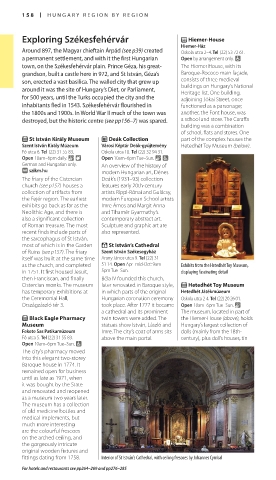
fittings dating from 1758. Interior of St István’s Cathedral, with ceiling frescoes by Johannes Cymbal hours from 10am to 6pm. The The romantic Bory Castle, a blend of architectural styles
For hotels and restaurants see pp264–269 and pp276–285
158-159_EW_Hungary.indd 158 14/11/2017 16:48 158-159_EW_Hungary.indd 159 18/09/17 3:40 pm

