


Page 253 - (DK Eyewitness) Travel Guide - Hungary
P. 253
THE GREA T PLAIN 251
The Horsemen of the Great Plain
Since AD 900, when Magyar horsemen struck fear into the hearts of all who crossed their
paths as they rode through the Carpathians into Western Europe, Hungarians have been
renowned for their excellence in horsemanship. For more than 1,000 years, Hungarian
military and econ omic power relied in many respects on the skill of its horsemen, and on
the sturdiness of the short-necked horses they rode, since much of the country’s history
took place on horseback. While the romantic nomads of yore have long since disap-
peared, the Hungarian traditions of horsemanship are preserved in the many equestrian
centres on the Great Plain, which offers an ideal climate for riding tours and hunting.
Horsemen put on shows with great feats of horsemanship (such as the Puszta Fiver, see
p239), and the enterprise of breeding thoroughbreds has enjoyed a renaissance.
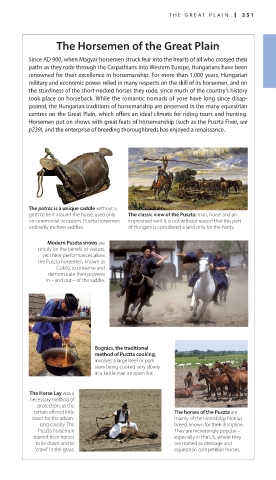
The patrac is a unique saddle without a
girth to tie it around the horse, used only The classic view of the Puszta: man, horse and an
on ceremonial occasions: Puszta horsemen improvised well. It is not without reason that this part
ordinarily eschew saddles. of Hungary is considered a land only for the hardy.
Modern Puszta shows are
strictly for the benefit of visitors,
yet these performances allow
the Puszta horsemen, known as
Csikós, to preserve and
demonstrate their prowess
in – and out – of the saddle.
Bogrács, the traditional
method of Puszta cooking,
involves a large beef or pork
stew being cooked very slowly
in a kettle over an open fire.
The Horse Lay was a
necessary method of
protection, as the
terrain offered little The horses of the Puszta are
cover for the advan mainly of the Hortobágy Nonius
cing cavalry. The breed, known for their discipline.
Puszta horsemen They are increasingly popular –
trained their horses especially in the US, where they
to lie down and to are trained as dressage and
“crawl” in the grass. equestrian competition horses.
250-251_EW_Hungary.indd 251 18/09/17 3:41 pm

