


Page 252 - (DK Eyewitness) Travel Guide - Hungary
P. 252
250 HUNGAR Y REGION B Y REGION THE GREA T PLAIN 251
w Jászberény
50 km (31 miles) east of Budapest. The Horsemen of the Great Plain
Road Map D3. * 27,000.
£ from Szolnok, Budapest. @ from Since AD 900, when Magyar horsemen struck fear into the hearts of all who crossed their
Kecskemét. n Tourinform, Lehel paths as they rode through the Carpathians into Western Europe, Hungarians have been
vezér tér 33, (57) 40 64 39. _ Csángó renowned for their excellence in horsemanship. For more than 1,000 years, Hungarian
Folk lore Festival (early Aug).
military and econ omic power relied in many respects on the skill of its horsemen, and on
Jászberény is named for the the sturdiness of the short-necked horses they rode, since much of the country’s history
Jász, an allegedly Iranian people took place on horseback. While the romantic nomads of yore have long since disap-
who settled in the area around peared, the Hungarian traditions of horsemanship are preserved in the many equestrian
1200. A number of other towns centres on the Great Plain, which offers an ideal climate for riding tours and hunting.
and villages in the region bear Horsemen put on shows with great feats of horsemanship (such as the Puszta Fiver, see
the Jász- prefix, yet there is
nothing to set apart the Jász p239), and the enterprise of breeding thoroughbreds has enjoyed a renaissance.
today. Their Persian language
has long been assimilated, and
their heritage is preserved only
in the Jász Museum, the main
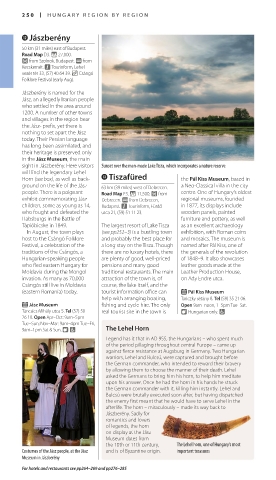
sight in Jászberény. Here visitors Sunset over the man-made Lake Tisza, which incorporates a nature reserve
will find the legendary Lehel
Horn (see box), as well as back- e Tiszafüred the Pál Kiss Museum, based in
ground on the life of the Jász 63 km (39 miles) west of Debrecen. a Neo-Classical villa in the city
people. There is a poignant Road Map E3. * 11,500. £ from centre. One of Hungary’s oldest
exhibit commem orating Jász Debrecen. @ from Debrecen, regional museums, founded
children, some as young as 14, Buda pest. n Tourinform, Fürdő in 1877, its displays include The patrac is a unique saddle without a
who fought and defeated the utca 21, (59) 51 11 23. wooden panels, painted girth to tie it around the horse, used only The classic view of the Puszta: man, horse and an
Habs burgs in the Battle of furniture and pottery, as well on ceremonial occasions: Puszta horsemen improvised well. It is not without reason that this part
Tápióbicske in 1849. The largest resort of Lake Tisza as an excellent archaeology ordinarily eschew saddles. of Hungary is considered a land only for the hardy.
In August, the town plays (see pp252–3) is a bustling town exhib ition, with Roman coins
host to the Csángó Folklore and probably the best place for and mosaics. The museum is
Modern Puszta shows are
Festival, a cele bration of the a long stay on the Tisza. Though named after Pál Kiss, one of strictly for the benefit of visitors,
traditions of the Csángós, a there are no luxury hotels, there the generals of the revolution yet these performances allow
Hungarian-speaking people are plenty of good, well-priced of 1848–9. It also show cases the Puszta horsemen, known as
who fled eastern Hungary for pensions and many good leather goods made at the Csikós, to preserve and
Moldavia during the Mongol traditional restaurants. The main Leather Production House, demonstrate their prowess
invasion. As many as 70,000 attraction of the town is, of on Ady Endre utca. in – and out – of the saddle.
Csángós still live in Moldavia course, the lake itself, and the
(eastern Romania) today. tourist information office can E Pál Kiss Museum
help with arranging boating, Tariczky sétány 8. Tel (59) 35 21 06.
E Jász Museum fishing and cycle hire. The only Open 9am–noon, 1–5pm Tue–Sat.
Táncsics Mihály utca 5. Tel (57) 50 real tourist site in the town is 8 Hungarian only. 7
26 10. Open Apr–Oct: 9am–5pm
Tue–Sun; Nov–Mar: 9am–4pm Tue–Fri,
9am–1pm Sat & Sun. 8 7 The Lehel Horn
Legend has it that in AD 955, the Hungarians – who spent much
of the period pillaging throughout central Europe – came up Bogrács, the traditional
against fierce resistance at Augsburg in Germany. Two Hungarian method of Puszta cooking,
warriors, Lehel and Bulcsú, were captured and brought before involves a large beef or pork
the German commander, who intended to reward their bravery stew being cooked very slowly
by allowing them to choose the manner of their death. Lehel in a kettle over an open fire.
asked the Germans to bring him his horn, to help him meditate
upon his answer. Once he had the horn in his hands he struck
the German com mander with it, killing him instantly. Lehel and
Bulcsú were brutally executed soon after, but having dispatched The Horse Lay was a
the enemy first meant that he would have to serve Lehel in the necessary method of
afterlife. The horn – miraculously – made its way back to protection, as the
Jászberény. Sadly for terrain offered little The horses of the Puszta are
romantics and lovers cover for the advan mainly of the Hortobágy Nonius
of legends, the horn cing cavalry. The breed, known for their discipline.
on display at the Jász Puszta horsemen They are increasingly popular –
Museum dates from trained their horses especially in the US, where they
the 10th or 11th century, The Lehel horn, one of Hungary’s most to lie down and to are trained as dressage and
Costumes of the Jász people, at the Jász and is of Byzantine origin. important treasures “crawl” in the grass. equestrian competition horses.
Museum in Jászberény
For hotels and restaurants see pp264–269 and pp276–285
250-251_EW_Hungary.indd 250 18/09/17 3:41 pm 250-251_EW_Hungary.indd 251 18/09/17 3:41 pm

