


Page 78 - (DK Eyewitness) Travel Guide - Hungary
P. 78
76 BUD APEST AREA B Y AREA GELLÉR T HILL AND T ABÁN 77
The monument’s central After much debate in the early
figure is a woman standing 1960s, the Citadel became a
on a pedestal, reaching a leisure complex. A restaurant,
height of 14 m (46 ft). At the a hotel and a nightclub here
base of the monument there used to tempt cust omers up
are two allegorical compositions, Gellért Hill, but are now closed,
representing progress and the with no information available
battle with evil. on when, or whether, they will
The arrival of the Russians in reopen. However, the walk up
Budapest was a liberation, but to the old walls of the Citadel
it also signalled the beginning is rewarded with spectacular
of Soviet rule. After the fall views of the entire city below.
of Commu nism, a figure of a
Russian soldier was removed 5 Statue of St Gellért
from the monument to The main plunge pool at the Rudas Baths, covered by a Turkish cupola
Memento Park (see p116). Szent Gellért emlékmű
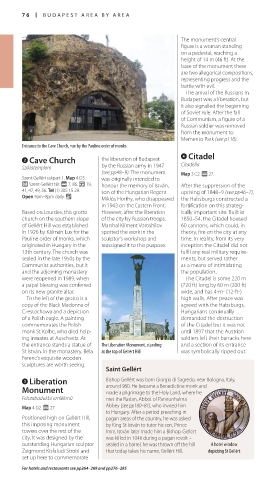
Entrance to the Cave Church, run by the Pauline order of monks Map 3 C2. @ 27 (and a long walk; go a Hungarian convert to 6 Rudas Baths
4 Citadel via the steps by Elizabeth Bridge). Christianity kneels at his feet. Rudas Gyógyfürdő
2 Cave Church the liberation of Budapest The statue was designed Döbrentei tér 9. Map 3 C2. Tel (1) 356
Sziklatemplom by the Russian army in 1947 Citadella In 1904 a vast monument was by Gyula Jankovits; the semi- 13 22. Spa Baths: Open (men only)
(see pp48–9). The monument Map 3 C2. @ 27. established on the spot where, circular colonnade behind it 6am–8pm Mon, Wed–Fri; (women
Szent Gellért rakpart 1. Map 4 D3. was originally intended to in the 11th century, Bishop is by Imre Francsek. A spring only) 6am–8pm Tue; (mixed) 10pm–
q Szent Gellért tér. @ 7, 86. v 19, honour the memory of István, After the suppression of the Gellért was said to have been that bubbles up here was 4am Fri, 6am–8pm, 10pm–4am Sat,
41, 47, 49, 56. Tel (1) 385 15 29. son of the Hungarian Regent uprising of 1848–9 (see pp46–7), thrown off the hill in a sealed used to create the fountain. 6am–7pm Sun. Swimming pool:
Open 9am–8pm daily. & Miklós Horthy, who disappeared the Habsburgs constructed a barrel, by a mob opposed to Overlooking the Elizabeth Open 6am–6pm Mon–Fri, 6am–5pm
in 1943 on the Eastern Front. fortification on this strate g- the adoption of Christianity. Bridge, the larger-than-life Sat & Sun. ∑ rudasfurdo.hu
Based on Lourdes, this grotto However, after the liberation ically important site. Built in St Gellért holds a cross in monument of the bishop can
church on the southern slope of the city by Russian troops, 1850–54, the Citadel housed his outstretched hand, and be seen from all over the city. Dating originally from 1550, these
of Gellért Hill was established Marshal Kliment Voroshilov 60 cannons, which could, in baths were greatly extended
in 1926 by Kálmán Lux for the spotted the work in the theory, fire on the city at any in 1566 by Sokoli Mustafa, an
Pauline order of monks, which sculptor’s workshop and time. In reality, from its very Ottoman pasha. The main part
originated in Hungary in the reassigned it to this purpose. inception the Citadel did not of the baths, which comprises an
13th century. The church was fulfil any real military require- octagonal plunge pool and four
sealed in the late 1950s by the ments, but served rather small corner pools with water of
Com munist authorities, but it as a means of intimidating varying temperatures, dates from
and the adjoining monastery the population. this period.
were reopened in 1989, when The Citadel is some 220 m In recent years the baths have
a papal blessing was conferred (720 ft) long by 60 m (200 ft) been extensively mod ernized
on its new granite altar. wide, and has 4-m- (12-ft-) and now include a covered
To the left of the grotto is a high walls. After peace was swimming pool. This pool is
copy of the Black Madonna of agreed with the Habsburgs, for mixed bathing.
Czestochowa and a depiction Hungarians continually
of a Polish eagle. A painting demanded the destruction
commemorates the Polish of the Citadel but it was not 7 Queen Elizabeth
monk St Kolbe, who died help- until 1897 that the Austrian Monument
ing inmates at Auschwitz. At soldiers left their barracks here
the entrance stands a statue of The Liberation Monument, standing and a section of its entrance Erzsébet királyné szobra
St István. In the monastery, Béla at the top of Gellért Hill was symbolically ripped out. Döbrentei tér. Map 3 C1/2.
Ferenc’s exquisite wooden
sculptures are worth seeing. This monument to Queen
Saint Gellért Elizabeth, wife of Habsburg
3 Liberation Bishop Gellért was born Giorgio di Sagredo, near Bologna, Italy, Emperor and king of Hungary
Franz Joseph, was created by
Monument around 980. He became a Benedictine monk and György Zala. The statue was
made a pilgrimage to the Holy Land, where he
Felszabadulási emlékmű met the Raslan, Abbot of Pannonhalma erected in its present location
Map 4 D2. @ 27. Abbey (see pp180–81), who invited him in 1986. It stands close to the
to Hun gary. After a period preaching in Elizabeth Bridge, which was
Positioned high on Gellért Hill, pagan areas of the country, he was asked also named after the empress
this imposing monument by King St István to tutor his son, Prince and queen, who showed great
towers over the rest of the Imre. István later made him a Bishop. Gellért friend ship to the Hun garians.
city. It was designed by the was killed in 1046 during a pagan revolt – The statue stood on the opposite
outstanding Hungarian sculptor sealed in a barrel, he was thrown off the hill A hotel window side of the river from 1932 until
Zsigmond Kisfaludi Strobl and that today takes his name, Gellért Hill. depicting St Gellért 1947, when the Communists
set up here to commemorate The landmark Gellért Monument, overlooking the Elizabeth Bridge ordered it to be taken down.
For hotels and restaurants see pp264–269 and pp276–285
076-077_EW_Hungary.indd 76 18/09/17 3:39 pm 076-077_EW_Hungary.indd 77 18/09/17 3:39 pm

