


Page 80 - (DK Eyewitness) Travel Guide - Hungary
P. 80
78 BUD APEST AREA B Y AREA GELLÉR T HILL AND T ABÁN 79
8 Tabán Eravi were the first to make a In the late 17th century, a 9 Rác Thermal Spa
Map 3 B/C1. v 18, 19. @ 5, 112. settlement here, while the large number of Serbs, referred Rác Gyógyfürdő
Romans later built a watch to in Hungarian as Rác, moved Hadnagy utca 8–10. Map 3 C2. v 18,
The Tabán now consists of tower from which they could into the Tabán after fleeing 19. Closed until further notice.
a pleasant park and a few observe people using a nearby from the Turks. They were
historic buildings, but it was crossing point over the river. joined by Greeks and Gypsies. The Rác Spa dates from 1550
once very different. In the The first reference to the Many of the inhabitants of and boasts an original thermal
early 20th century this dis trict, thermal waters in Tabán dates the Tabán at this stage were Turkish pool, a hammam bath
nestling in between Castle from the 15th century. The tanners or made their living on and a historical dome. This
Hill and Gellért Hill, was a slum Turks took advantage of this the river. On the hillside above, significant piece of heritage is
which was cleared as part natural asset and built two grapevines were cultivated. In now privately owned, and has
of a city improvement pro magnificent baths here, the the early 20th century, though been renovated with a fivestar The History of Healing: permanent exhibition at Semmelweis Museum of Medical History
gramme. Only a few buildings Rác Baths and the Rudas picturesque, the district was luxury hotel adjoining it, with
survived, inclu ding Tabán Baths (see p77). Around them still without proper sanitation. modern facilities for guests and now in the Budapest History of a 19thcentury pharmacy.
Parish Church. a blossoming town was soon The old, decaying Tabán, visitors to indulge in the latest Museum (see p60). The nave Semmelweis’s surgery can
Natural conditions ensured established. Apart from the with its bars and gambling spa treatments. Unfortunately, and side chapels are Baroque; also be seen with its original
that this was one of the first baths, virtually everything dens, was demolished the opening of the hotel and the altar, pulpit and several furniture. In the courtyard
places in the area where was destroyed in the recapture and the present green space thermal spa complex has been paintings adorning the walls stands a monument called
people chose to live. The Celtic of Buda in 1686. established in its place. delayed by unresolved all date from the 19th century. Motherhood by Miklós Borsos.
financial issues. The church hosts regular The museum joined the
organ concerts. Hungarian National Museum
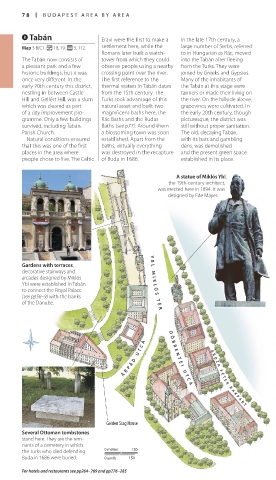
A statue of Miklós Ybl, in February 2017, thus
the 19thcentury architect, becoming a department
was erected here in 1894. It was q Semmelweis of the institution.
designed by Ede Mayer. Museum of Medical
History 9 Várkert Bazár
Semmelweis Orvostörténeti
Múzeum Várbazár
Ybl Miklós tér 6. Map 4 D1.
Apród utca 1–3. Map 3 C1. Tel (1) 375 Tel (06 1) 225 05 54. @ 16, 86, 105.
35 33. v 18, 19. Open MidMar–Oct: v 19. Open 10am–6pm Tue–Sun.
10:30am–6pm Tue–Sun; Sep–mid ∑ varkertbazar.hu/en
Mar: 10:30am–4pm Tue–Sun. & 8
^ ∑ semmelweis.museum.hu
Turkish bath area, Rác Thermal Spa Designed by Miklós Ybl,
Y
B
Gardens with terraces, L This museum is located in the the Várkert Bazár and the
decorative stairways and 18thcentury house where ornamental garden that it
M
arcades designed by Miklós I 0 Tabán Parish Dr Ignáz Semmelweis was born houses have been popular
Ybl were established in Tabán L Church in 1818. He is renowned for landmarks ever since they
K
to connect the Royal Palace Ó his discovery of the cause and opened in 1883. Considered
(see pp58–9) with the banks S Tabáni plébánia templom cure for puerperal fever, a fatal to be the greatest examples
of the Danube. T Attila út 11. Map 3 C1. Tel (1) 375 54 condition frequently contracted of the Hungarian Romantic
É
91. v 18, 19. by women during or shortly style of architecture, the venue
R
after childbirth. became one of the city’s best
A temple is thought to have The history of medicine clubs during the 20th century.
stood on this site even in the from ancient Egypt onwards It was finally closed for renov
D
reign of Prince Árpád. In the Mid is portrayed in the museum, ations in 1984, and reopened as
Ö
A B
C R dle Ages a church was built here, which includes the replica a public cultural space in 2014.
T E which was con verted to a
U N T mosque by the Turks and
Á R P Á D E I U subsequently destroyed. In Raoul Wallenberg
1728–36, after the Habsburgs
The celebrated Swedish diplomat
had taken control of the city, Raoul Wallenberg saved more than 7,000
T
C
a new church was erected to a
A Hungarian Jews from deportation. Born in
design by Keresztély Ober gruber. Sweden in 1912, Wallen berg was assigned
Mátyás Nepauer added the to the Swedish Embassy in Budapest
tower in 1750–53. In 1881 the in 1944 and immediately began
G R O Z A P É T E R R A K P A R T
façade was extended and certifying Jews threatened with
the tower was crowned by deportation as Swedish subjects
Golden Stag House a fine NeoBaroque dome. awaiting repatriation. Arrested (as
a US spy) by the Soviet Army in 1945,
Several Ottoman tombstones Inside the church, on the Wallenberg was taken to Moscow and
stand here. They are the rem righthand side under the probably executed in 1947. He is honoured
nants of a cemetery in which choir gallery, is a copy of a in Budapest with a statue depicting a man Bas-relief of Raoul
the Turks who died defending 0 metres 150 12thcentury carving entitled slaying a snake. Wallenberg
Buda in 1686 were buried. 0 yards 150 Christ of Tabán; the original is
For hotels and restaurants see pp264–269 and pp276–285
078-079_EW_Hungary.indd 78 18/09/17 3:37 pm 078-079_EW_Hungary.indd 79 18/09/17 3:37 pm

