


Page 79 - (DK Eyewitness) Travel Guide - Hungary
P. 79
GELLÉR T HILL AND T ABÁN 77
After much debate in the early
1960s, the Citadel became a
leisure complex. A restaurant,
a hotel and a nightclub here
used to tempt cust omers up
Gellért Hill, but are now closed,
with no information available
on when, or whether, they will
reopen. However, the walk up
to the old walls of the Citadel
is rewarded with spectacular
views of the entire city below.
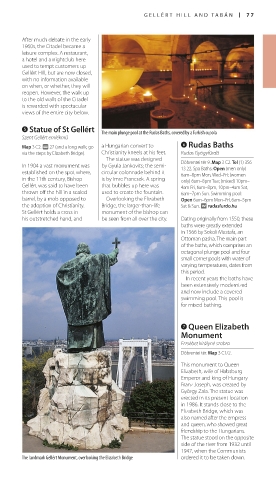
5 Statue of St Gellért The main plunge pool at the Rudas Baths, covered by a Turkish cupola
Szent Gellért emlékmű
Map 3 C2. @ 27 (and a long walk; go a Hungarian convert to 6 Rudas Baths
via the steps by Elizabeth Bridge). Christianity kneels at his feet. Rudas Gyógyfürdő
The statue was designed Döbrentei tér 9. Map 3 C2. Tel (1) 356
In 1904 a vast monument was by Gyula Jankovits; the semi- 13 22. Spa Baths: Open (men only)
established on the spot where, circular colonnade behind it 6am–8pm Mon, Wed–Fri; (women
in the 11th century, Bishop is by Imre Francsek. A spring only) 6am–8pm Tue; (mixed) 10pm–
Gellért was said to have been that bubbles up here was 4am Fri, 6am–8pm, 10pm–4am Sat,
thrown off the hill in a sealed used to create the fountain. 6am–7pm Sun. Swimming pool:
barrel, by a mob opposed to Overlooking the Elizabeth Open 6am–6pm Mon–Fri, 6am–5pm
the adoption of Christianity. Bridge, the larger-than-life Sat & Sun. ∑ rudasfurdo.hu
St Gellért holds a cross in monument of the bishop can
his outstretched hand, and be seen from all over the city. Dating originally from 1550, these
baths were greatly extended
in 1566 by Sokoli Mustafa, an
Ottoman pasha. The main part
of the baths, which comprises an
octagonal plunge pool and four
small corner pools with water of
varying temperatures, dates from
this period.
In recent years the baths have
been extensively mod ernized
and now include a covered
swimming pool. This pool is
for mixed bathing.
7 Queen Elizabeth
Monument
Erzsébet királyné szobra
Döbrentei tér. Map 3 C1/2.
This monument to Queen
Elizabeth, wife of Habsburg
Emperor and king of Hungary
Franz Joseph, was created by
György Zala. The statue was
erected in its present location
in 1986. It stands close to the
Elizabeth Bridge, which was
also named after the empress
and queen, who showed great
friend ship to the Hun garians.
The statue stood on the opposite
side of the river from 1932 until
1947, when the Communists
The landmark Gellért Monument, overlooking the Elizabeth Bridge ordered it to be taken down.
076-077_EW_Hungary.indd 77 18/09/17 3:39 pm

