


Page 88 - (DK Eyewitness) Travel Guide - Hungary
P. 88
86 BUD APEST AREA B Y AREA AROUND P ARLIA MENT 87
from the prehistoric era to the the shooting at Kossuth tér
20th century. A map dating on 25 October 1956, when Secession Architecture
from 1909 shows the settlement a peace ful demonstration
areas of the various groups who during the revolution turned Visitors to Budapest are often impressed by its wonderful range of late 19th- and early
came to be included in Hungary. violent. The two sculptures in 20th-century buildings. The majority of these are found in central Pest and around the
Ethnic items relating to these front of the building are by Városliget district (see pp110–11); Buda was already developed at this stage and so boasts
communities, as well as early Árpád Somogyi: the Reaper
artifacts of the peoples of North Lad (1956) and the Female few examples. The Secession Movement started among groups of avant-garde artists in
and South America, Africa, Asia Agronomist (1954). Paris and Vienna, from where the term “Secession” comes. In Budapest, the Secessionist
and Australia, can also be seen. style was also the inspiration for what would develop into the Hungarian National style.
4 Liberty Square Secessionist architecture is characterized by decorative forms, glazed ceramics and the
3 Ministry of Szabadság tér artistic implementation of modern technical solutions.
Agriculture Map 2 D4. q Kossuth Lajos tér,
Földművelésügyi Minisztérium Arany János utca. The former Post
Savings Bank
Kossuth Lajos tér 11. Map 2 D4. After the demolition of the has a splendid
q Kossuth Lajos tér. main staircase
The magnificent façade of the Neu gebäude Barracks in 1886, Ödön Lechner (1845– designed by
Museum of Ethnography Liberty Square was laid out in 1914), Hungary’s most Ödön Lechner. It
On the southeastern side of their place. The barracks, built influential Secessionist is embellished by
2 Museum of Kossuth Square is a huge building, for the Austrian troops, once architect, combined fine balusters,
Ethnography bordered by streets on all four sides, dominated the southern part modern functionalism spherical lamps
Néprajzi Múzeum which was built for the Ministry of Lipótváros (Leopold Town). and characteristically and decorative
of Agri culture by Gyula Bukovics It was here that Hungary’s first decorative forms. window frames.
Kossuth Lajos tér 12. Map 2 D3. at the end of the 19th century. independent prime minister,
Tel (1) 473 24 42. v 2, 70. q Kossuth The façade is designed in a Count Lajos Batthyány, was
Lajos tér. Closed for renovation. typical late Historicist style, executed on 6 October 1849.
& 8∑ neprajz.hu drawing heavily on Neo- Since 1926, an eternal flame The Geological and Geophysical
Institute of Hungary is
Classical motifs. The columns has been burning at the corner characterized by its stunning
This building, designed by Alajos of the colonnade are echoed of Aulich utca, Hold utca and blue Zsolnay ceramic roof
Hauszmann and constructed in the well-proportioned Báthory utca to honour all tiles. Designed by Ödön
between 1893 and 1896, was pedimented windows above. who were executed. Lechner, the building
built as the Palace of Justice On the wall to the right of the Two impressive buildings dates from 1898–9. The
and, until 1945, served as the building, two commemorative by Ignác Alpár stand on central pitched roof is
Supreme Court. plaques can be seen. The first is opposite sides of the square. topped by four human
The building’s design links dedicated to the commanding The former Stock Exchange figures bent under the
elements of Renaissance, Baroque officer of the Polish Legion, who dates from 1905 and shows weight of a large globe.
and Classicism. The façade is was also a hero of the 1848–9 the influence of the Secession
dominated by a vast portico uprising (see pp46). Brigadier style. The Hungarian National Finely crafted peacocks, a classic
crowned by two towers. A gable Woroniecki, renowned for his Bank (Magyar Nemzeti Bank), Secession motif, adorn the
features the figure of the Roman bravery, was shot down on this also from 1905, is decorated in This vase by István Sovának stands wrought-iron gates of Gresham
god dess of justice in a chariot spot by the Austrians in 1849. Historicist style. An obelisk by in the Museum of Applied Arts. Its plain Palace. This former office block, now
shape and Oriental flower motif hint at
drawn by three horses, created The second plaque honours Károly Antal at the northern the many Eastern elements that crept a luxury hotel (see p88), was built by
by Károly Senyei. The grand hall Endre Ságvári, a Hungarian end of the square commem- into later Secessionist works of art. Zsigmond Quittner in 1905–7.
inside the main entrance boasts hero of the resistance orates the Red Army soldiers
a marvellous staircase and movement, who died when who died during the siege of
frescoes by Károly Lotz. fighting the Fascists in 1944. Budapest in 1944–5. A second
The building was first used The metal balls studding statue honours US General
as a museum in 1957, housing one part of the wall are set into Harry Hill Bandholtz, who foiled
the Hungarian National Gallery bullet holes and form a mem- the looting of the Hungarian
(see pp62–3), which was later orial for the civilian victims of National Museum.
transferred to the Royal Palace.
The Museum of Ethnography
has been here since 1973. This window at the
The museum’s collection Hungarian National
was established in 1872, in Bank was created by
the Department of Ethno graphy Miksa Róth in 1905.
at the Hungarian National Róth (1865–1944) was
Museum (see pp102–3). There Hungary’s leading Reinforced concrete, steel and glass
are now around 240,000 exponent of stained- were often used together to create
exhibits, although most are glass windows. His large, light interiors. The foyer of the
not on display. The collection windows also adorn Gellért Hotel and Baths Complex is a
includes artifacts reflecting the Budapest’s Parliament. perfect example of this technique.
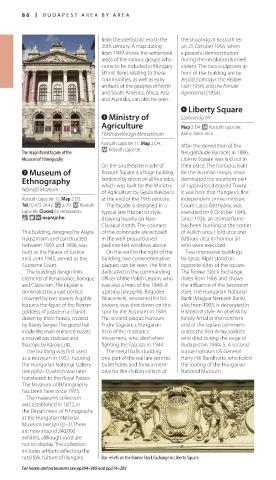
rural folk culture of Hungary Bas-reliefs on the former Stock Exchange in Liberty Square
For hotels and restaurants see pp264–269 and pp276–285
086-087_EW_Hungary.indd 86 18/09/17 3:39 pm 086-087_EW_Hungary.indd 87 18/09/17 3:39 pm

