


Page 89 - (DK Eyewitness) Travel Guide - Hungary
P. 89
AROUND P ARLIA MENT 87
Secession Architecture
Visitors to Budapest are often impressed by its wonderful range of late 19th- and early
20th-century buildings. The majority of these are found in central Pest and around the
Városliget district (see pp110–11); Buda was already developed at this stage and so boasts
few examples. The Secession Movement started among groups of avant-garde artists in
Paris and Vienna, from where the term “Secession” comes. In Budapest, the Secessionist
style was also the inspiration for what would develop into the Hungarian National style.
Secessionist architecture is characterized by decorative forms, glazed ceramics and the
artistic implementation of modern technical solutions.
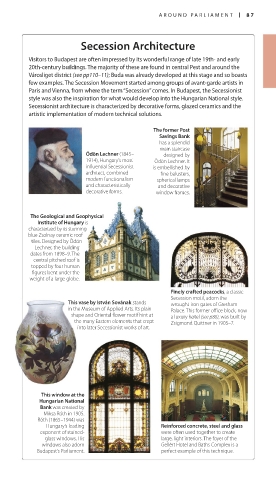
The former Post
Savings Bank
has a splendid
main staircase
Ödön Lechner (1845– designed by
1914), Hungary’s most Ödön Lechner. It
influential Secessionist is embellished by
architect, combined fine balusters,
modern functionalism spherical lamps
and characteristically and decorative
decorative forms. window frames.
The Geological and Geophysical
Institute of Hungary is
characterized by its stunning
blue Zsolnay ceramic roof
tiles. Designed by Ödön
Lechner, the building
dates from 1898–9. The
central pitched roof is
topped by four human
figures bent under the
weight of a large globe.
Finely crafted peacocks, a classic
Secession motif, adorn the
This vase by István Sovának stands wrought-iron gates of Gresham
in the Museum of Applied Arts. Its plain Palace. This former office block, now
shape and Oriental flower motif hint at a luxury hotel (see p88), was built by
the many Eastern elements that crept Zsigmond Quittner in 1905–7.
into later Secessionist works of art.
This window at the
Hungarian National
Bank was created by
Miksa Róth in 1905.
Róth (1865–1944) was
Hungary’s leading Reinforced concrete, steel and glass
exponent of stained- were often used together to create
glass windows. His large, light interiors. The foyer of the
windows also adorn Gellért Hotel and Baths Complex is a
Budapest’s Parliament. perfect example of this technique.
086-087_EW_Hungary.indd 87 18/09/17 3:39 pm

